



March and April 2026 drawdowns may have structural implications as Bitcoin ETF holders stay steady.
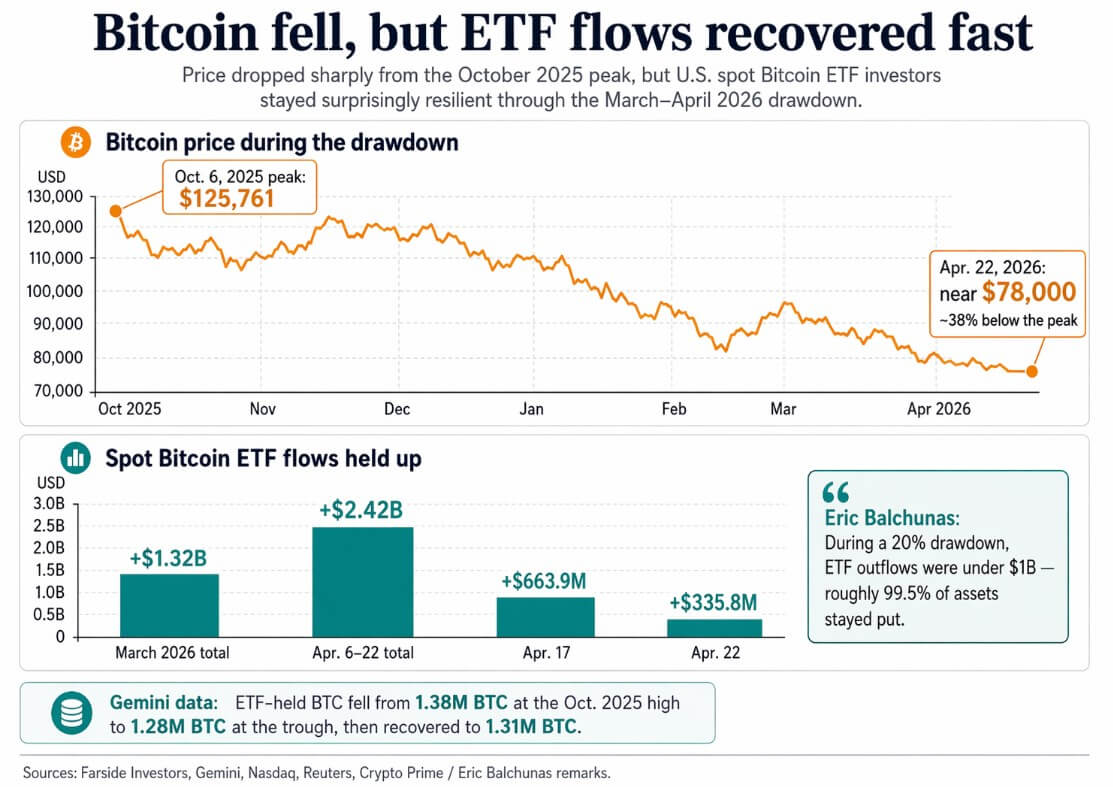
Bitcoin is hovering round $78,000, about 38% under its Oct. 6 peak of $125,761, and the U.S. Spot Bitcoin ETF noticed inflows of $1.32 billion in March, reversing 4 consecutive months of outflows. The ETF then added an extra $2.42 billion in internet inflows from April 6 to April 22.
The perfect days have been April seventeenth with $663.9 million in inflows and April twenty second with $335.8 million inflows. In keeping with Gemini’s coin-level knowledge, the ETF’s Bitcoin holdings solely fell from a excessive of 1.38 million BTC in October 2025 to a low of 1.28 million BTC, earlier than shortly recovering to 1.31 million BTC.

Eric Balchunas, senior ETF analyst at Bloomberg, stated in an interview with Crypto Prime that through the 20% drawdown, the ETF recorded outflows of lower than $1 billion, or about 99.5% of its belongings. This occurred throughout a very hostile macro window.
In keeping with Nasdaq’s March replace, digital asset market capitalization fell by 21% within the first quarter, with the Nasdaq 100 down 4.9% and the S&P 500 down 5.1%. ETF holders soaked all of it up with out creating the wave of exits that skeptics had predicted.
Balciunas argued that the promoting strain is coming from long-term crypto holders, saying the voice is “coming from inside.”
ETF analysts’ interpretations are in step with the circulate knowledge: Whereas the ETF remained net-buying regardless of its traditionally sharp drawdown, different elements pushed costs down.
several types of patrons
The ETF wrapper locations Bitcoin inside a mannequin portfolio, advisor guardrails, committee-approved place limits, and rebalancing schedules.
Consumers in these buildings function throughout regular buying and selling hours and are due to this fact constrained by laws. In drawdown, constraints appear to be self-discipline.
| Purchaser kind | typical rapper | behavioral constraints | Conduct that will lead to drawdown |
|---|---|---|---|
| Spot Bitcoin ETF holders | ETF/Safety account | Mannequin portfolios, advisor guidelines, place limits, buying and selling hours, rebalancing schedules | Prone to maintain or rebalance regularly |
| Conventional Crypto Native Holders | Direct possession of cash | Fewer formal portfolio guardrails | Improve in discretionary gross sales |
| leverage dealer | Everlasting/margin venue | Liquidation threat, collateral strain | Compelled gross sales might speed up |
| Authorized entity/monetary holder | Stability sheet allocation | Monetary coverage, liquidity wants | Risk of divestiture based mostly on company-level constraints |
| miner | Native BTC holdings | Working prices, monetary wants | Promoting might happen searching for liquidity |
Bitwise and VettaFi’s 2026 Advisor Survey discovered that 32% of monetary advisors had an allocation to cryptocurrencies of their consumer accounts in 2025, up from 22% the earlier 12 months, 42% stated they have been in a position to buy cryptocurrencies of their consumer accounts, and 77% cited ETFs as their most well-liked car.
EY-Parthenon and Coinbase’s 2026 Institutional Survey discovered that 73% of respondents plan to extend their digital asset allocation this 12 months, 66% already entry spot crypto by an ETF or ETP, and 81% favor registered autos to direct storage of their cash.
The framework for EY’s behavioral findings is that volatility is driving extra formal threat self-discipline.
BlackRock strengthened its sizing logic in late 2024, recommending a most allocation of two% for buyers excited by Bitcoin, noting that bigger weights can disproportionately change total portfolio threat.
A 2% sleeve absorbs a 38% drawdown of belongings, a suitable resistance for a diversified portfolio. This can lead to a slower hand.
On January 5, 2026, the distribution infrastructure continues to deepen, with Financial institution of America publishing suggestions for crypto ETPs to advisors throughout Merrill, Merrill Edge, and its non-public banks.
Morgan Stanley filed for a Bitcoin ETF in January, launched MSBT on April 8, and Charles Schwab introduced spot crypto buying and selling.
Every transfer directs extra Bitcoin purchases by channels the place compliance opinions, place sizing guidelines, and buyer settlement constraints management execution. Discretionary panic promoting is tougher to execute in these channels.
Totally different circumstances of this conduct
Within the bulls’ case, the possession base has already began to alter and can change into extra complicated over time.
As entry by advisors and institutional buyers expands, marginal patrons of Bitcoin have began holding small, long-term allocations based mostly on rebalancing guidelines.
On the subsequent drawdown, we see that patrons are much less more likely to withdraw and extra probably so as to add. The choice for registered autos in each advisor and institutional surveys, the modest contraction in ETF holdings throughout a extreme drawdown, and the pace of circulate restoration in April are all pointing in the identical course.
Citi’s 12-month bullish situation for Bitcoin targets $165,000, supported by sustained institutional demand and a constructive regulatory backdrop within the US.
The bearish case pinpoints the boundaries of that argument in a state of affairs the place the latest drawdown was by no means reached. ETF holders might show to be disciplined solely as much as a threshold as cease losses are triggered, margin calls hit mannequin portfolios, and allocation bands pressure reductions.
In that situation, the identical guidelines that created restraint through the decline would trigger the sell-off to speed up quickly. Citi’s unfavorable 12-month situation places the value of Bitcoin at $58,000, a ground clearly tied to stalled U.S. regulatory progress, depleting a significant ETF demand catalyst.
The bear case can be finished by redistribution. A extra disciplined set of ETF patrons might merely push Bitcoin volatility onto completely different actors, resembling leveraged merchants, perpetual futures markets, miners, and company treasury holders, who function with out guardrail rebalancing.
In keeping with this studying, the latest resilience of ETFs displays a benign macro window.
| situation | What occurs to ETF holders? | What occurs to different holders? | Market influence |
|---|---|---|---|
| bull case | Keep regular, rebalance, and perhaps add extra | Elevated promoting by leveraged merchants, miners, and legacy holders | The composition of possession is structurally altering. Drawdown is extra relaxed |
| fundamental case | Outflow is reasonable, however there is no such thing as a sudden enhance. | Blended promoting strain amongst crypto-native cohorts | ETFs cushion volatility on the margin, however don’t rewrite market conduct |
| bear case | Allocation bands, cease losses, or macro stress trigger elevated ETF promoting | Broad unfold of risk-off promoting throughout all cohorts | ETF resilience proves to be conditional, not structural |
| Key metrics to look at | ETF holdings BTC and internet flows through the subsequent 20%-30% decline | Relative promoting energy apart from ETFs | The perfect real-world take a look at of Balchunas’ paper |
The following 20% to 30% drawdown shall be a take a look at to see if the ETF’s BTC holdings contract quickly, or if flows shortly stabilize like they did in April. If latest patterns repeat, Balciunas’ interpretation will transfer nearer to documented market info.
A big-scale exit from the ETF below enough macro stress would affirm that the composition is maintained so long as situations enable.