



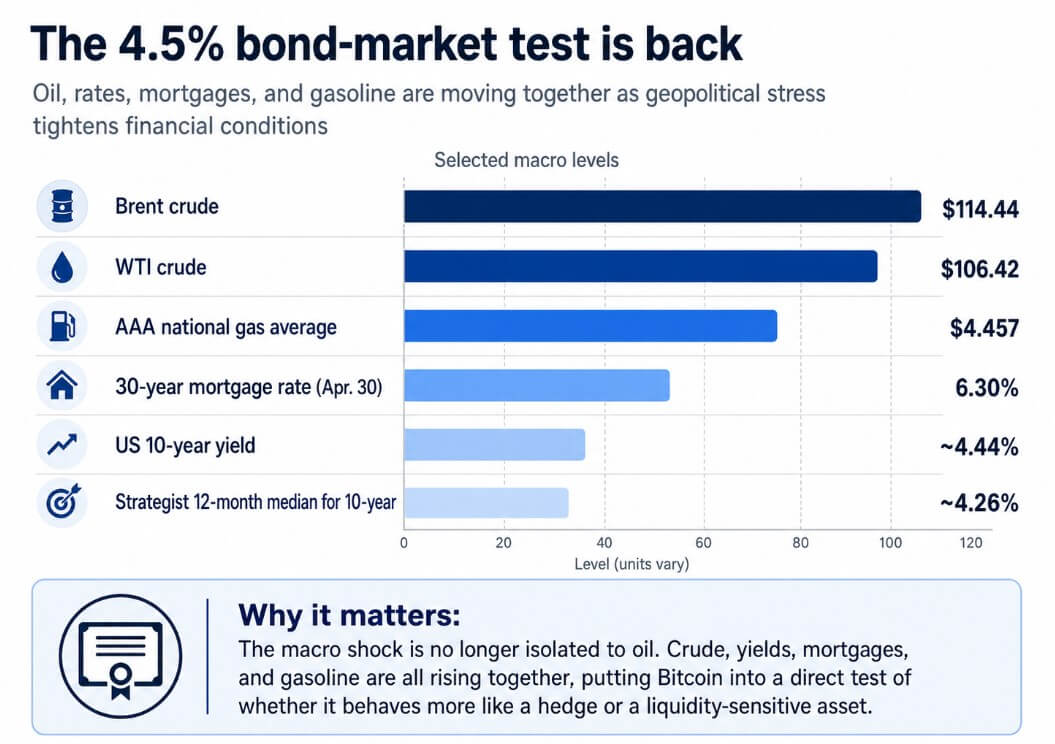
Iranian ship assaults within the Strait of Hormuz and drone strikes on the Fujairah oil business have brought about Brent crude oil to drop to $114.44 and WTI to $106.42, whereas 10-year Treasury yields have risen to about 4.44% and 30-year Treasury yields have topped 5%.
Bitcoin hit an intraday excessive of $80,717.66 on Could 4, testing its macro identification as a hedge towards monetary turmoil and as a liquidity-sensitive asset that struggles as yields rise and money turns into extra enticing.
Because the 10-year rate of interest approaches 4.5%, mortgage rates of interest, inventory valuations, and company borrowing will all be tightened accordingly. Freddie Mac had its 30-year fastened mortgage price at 6.30% as of April 30, already up from 6.23% the earlier week.
When rates of interest on 10-year bonds rose to 4.39% in late March because of adjustments in yields brought on by the warfare, mortgage rates of interest jumped to six.38%, and rose to six.46% in early April as considerations about rate of interest will increase grew.
The median 12-month forecast for the 10-year Treasury yield is about 4.26%, in line with a survey of strategists, and the market is already buying and selling about 20 foundation factors above that degree.
With round 20% of the world’s oil and LNG provides passing by way of the Strait of Hormuz, the market response shortly unfold from crude oil to rates of interest.
Eurasia Group warned that and not using a deal to reopen the Strait of Hormuz, U.S. gasoline costs might attain $5 a gallon, in contrast with AAA’s nationwide common of $4.457 as of Could 4. Each numbers signify inflation dangers that have an effect on rate of interest expectations and complicate the Fed’s place.
Fed issues
Barclays has pushed again its forecast for the Fed’s first price lower to March 2027, and CME FedWatch stated merchants see a roughly 78.7% likelihood of no change till the top of 2026.
With oil holding above $100, inflation has turn into sticky sufficient that the Fed can not lower rates of interest to cushion dangerous belongings, eliminating one of many cleaner tailwinds that Bitcoin has benefited from in current cycles.
Two forces are pushing up long-term bond yields. Whereas the power shock will increase inflation expectations, the Treasury’s personal borrowing calendar will exacerbate this dynamic. The Treasury Division at the moment expects to borrow $189 billion within the second quarter and $671 billion within the third quarter.
The bond selloff has an extended shelf life than any Iran headlines, as elevated provide to a market that’s already pricing in inflation threat will maintain yields rising even because the geopolitical premium fades.
The IMF’s Kristalina Georgieva stated on Could 4 that the IMF’s reverse state of affairs had already materialized, warning that oil costs might attain round $125 if the battle extends into 2027.
The Chevron CEO added that provided that Hormuz handles one-fifth of the world’s crude oil, bodily shortages will begin to seem.
The US is releasing as much as 92.5 million barrels from the Strategic Petroleum Reserve as a part of a broader IEA effort, however oil costs continued to rise and gasoline costs continued to rise. These numbers point out that coverage responses to take away the inflation premium from long-term rates of interest are inadequate.
| driver | Article content material | Why pricing issues |
|---|---|---|
| oil shock | Resulting from Iran-related escalation, Brent $114.44 And to WTI $106.42 | Inflation expectations rise because of rising power costs |
| holmes confusion | About 20% The world’s oil and LNG provides go by way of the strait. | Provide threat turns geopolitical occasions into macroinflationary occasions |
| Consumed maintain | Barclays has revised its preliminary price lower forecast to: March 2027; FedWatch signifies there’s seemingly no change till the top of 2026 | The Fed has much less room to ease threat belongings |
| Nationwide treasury borrowing | Treasury expects to borrow $189 billion 2nd quarter and $671 billion within the third quarter | Elevated provide places additional strain on long-term rate of interest yields |
| Coverage compliance limitations | Launched within the US at most 92.5M Barrels elevated from SPR, however crude oil holdings elevated | The market means that the response will not be sufficient. |
Bitcoin contradiction
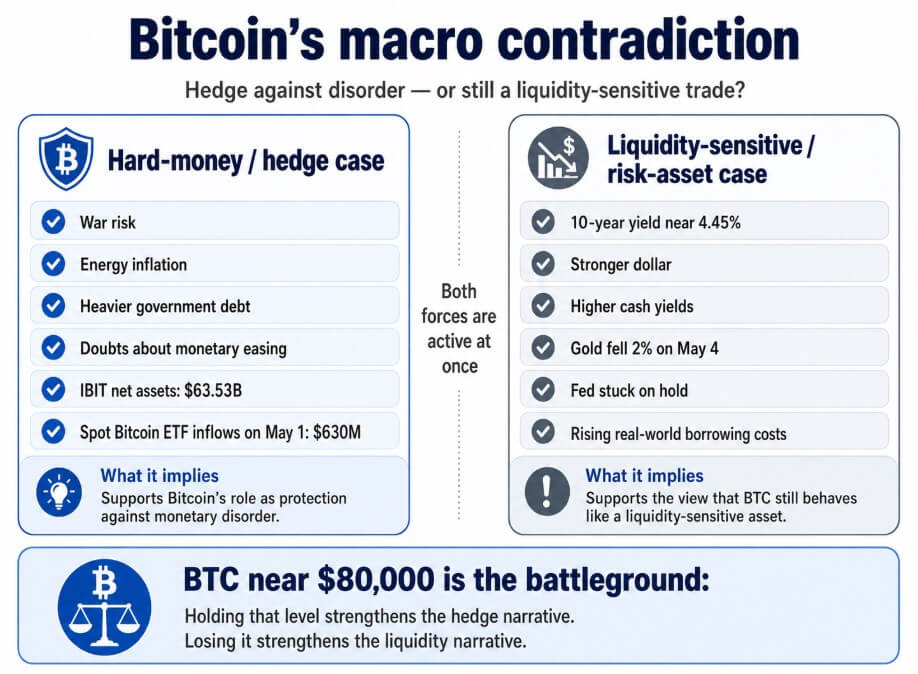
Bitcoin’s onerous cash litigation reinforces an setting of warfare dangers, power inflation, rising authorities debt, and doubts about financial lodging, all of which help the argument that fiat methods have gotten more durable to handle and costlier to function.
BlackRock’s IBIT had web belongings of $63.53 billion as of Could 1, and the U.S.-traded Spot Bitcoin ETF recorded inflows of $630 million on the identical day. Institutional sponsorship of this measurement displays the enduring view that Bitcoin belongs in a portfolio uncovered to macro-disorder.
Gold’s actions on Could 4 complicate the state of affairs. Regardless of the escalating state of affairs in Iran and hovering oil costs, gold fell 2% because of a robust greenback and hardening expectations for top rates of interest.
A stronger greenback and extra enticing money yields might overwhelm conventional hedging bids within the quick time period, and gold’s lack of expertise and adoption threat makes it a cleaner comparability.
The truth that Bitcoin is holding $80,000 regardless of the 10-year yield being near 4.45% would verify that institutional capital flows are making Bitcoin much less delicate to rates of interest. A break above this degree would reinforce the view that BTC will nonetheless operate as a liquidity-sensitive threat asset even when real-world yields rise and the greenback strengthens.
what to anticipate
In a bullish case, the geopolitical threat premium for oil must fade.
Because the transportation state of affairs improves and regular visitors resumes in Hormuz, yields are returning to across the median of 4.25% to 4.30%.
On this setup, the institutional infrastructure already in place comes into play, as IBIT’s measurement and ETF inflows give Bitcoin a robust bid. The onerous cash principle has survived the rate of interest take a look at and the market has reset the worth of BTC in direction of its current vary with out preventing the continuing bond sell-off.
Bitcoin’s structural purchaser base, together with company bonds, ETF flows, and sovereign-adjacent capital, may have extra room to build up at present ranges.
The bearish case develops if oil costs stay round $110 to $125, long-term yields decisively exceed 4.5%, and the inflation premium on rates of interest persists lengthy sufficient for the Fed’s long-term rate of interest hikes to dominate the market by way of 2026.
In that setting, Bitcoin trades like a liquidity-sensitive asset, particularly if the greenback continues to rise and gold continues to return a hedging premium.
Even when tensions with Iran quiet down, the Treasury provide image reinforces bearish sentiment as $671 billion in third-quarter borrowings will keep upward momentum in the long run, narrowing the room for liquidity-driven beneficial properties in Bitcoin.
Bitcoin’s long-term onerous cash principle survives the Fed’s long-term holdings, however holding $80,000 whereas 10-year yields are close to 4.45% and oil is buying and selling above $100 would require both the bond market to cease tightening monetary situations or there must be sufficient institutional inflows to soak up the rate of interest headwinds.