



Bitcoin’s return above $80,000 has as soon as once more raised questions that merchants have not needed to face on a big scale since 2020. How will the world’s largest digital asset fare when well being issues reasonably than rates of interest, regulation or crypto-native leverage headline the market’s most important dangers?
The rapid set off was an outbreak of hantavirus on the posh cruise ship MV Hondius, which was sure for the Canary Islands.
On Might 6, the World Well being Group (WHO) confirmed an outbreak of extreme respiratory sickness on board the ship, and introduced that as of Might 4, there have been two confirmed instances, 5 suspected instances, and three deaths.
This comes because the flagship digital asset traded as excessive as $82,752 earlier this week, extending a rally that restored confidence after months of unstable macro buying and selling.
However the timing of hantavirus headlines complicates the transfer. BTC is presently dealing with issues about its skill to soak up shocks that may as soon as have prompted widespread demand for money.
Hantavirus well being scare hits crowded buying and selling
In response to the WHO, hantaviruses are often transmitted via contact with contaminated rodents, together with publicity to urine, feces, and saliva. Most strains don’t unfold simply between folks.
Strains related to the MV Hondius cluster are regarded as Andes viruses. Andes virus is a South American variant that has attracted concern as a result of it is among the few hantaviruses related to human-to-human transmission amongst shut contacts.
The illness might be severe. Hantavirus cardiopulmonary syndrome has a mortality price of as much as 40% in components of the Americas, making suspected clusters troublesome for public well being officers and markets to disregard.
Nonetheless, WHO officers characterize the worldwide danger as extraordinarily low and primarily restricted to the ship surroundings.
That distinction is essential. The cruise ship cluster, which is present process intensive contact tracing, could be very completely different from the respiratory virus that spreads via main inhabitants facilities.
Nevertheless, market issues come from a window of uncertainty. The lengthy incubation interval of hantavirus infections complicates contact tracing, forcing merchants to react to official briefings, passenger actions and new instances earlier than the total image is understood.
In such data hole markets, costs are sometimes set low. Bitcoin’s rally above $80,000 was already placing strain on leveraged longs and profit-taking. New exterior shocks give short-term merchants a purpose to scale back publicity, even when the potential well being dangers stay restricted.
Why March 2020 nonetheless issues
Merchants proceed to recollect March 2020, when the WHO’s declaration of the coronavirus pandemic triggered some of the violent liquidity occasions in trendy market historical past.
Bitcoin entered its period with a rising repute as a hedge towards monetary turmoil. Through the first part of the coronavirus shock, that argument failed the market check. The token fell greater than 50% in about 48 hours, buying and selling beneath $4,000 at one level, as traders offered liquid belongings to boost money.
This episode confirmed that within the early levels of a systemic shock, liquidity might be extra essential than funding idea. Property like BTC that commerce across the clock might be offered rapidly and are sometimes a money machine for traders dealing with margin calls elsewhere.
Nevertheless, the concern of hantavirus is far smaller than that of the brand new coronavirus an infection in March 2020. To this point, there is no such thing as a proof of continued group unfold, no comparable danger of financial shutdown, and no signal that governments are getting ready pandemic-era restrictions.
Nevertheless, a proper pandemic declaration shouldn’t be needed for merchants to react defensively. An already surging market might be offered on headlines alone, particularly if the reference level is a earlier crash that also shapes cryptocurrency danger administration.
That is why this episode is much less a repeat of 2020 and extra a check of whether or not Bitcoin’s investor base has modified sufficient to forestall well being headlines from turning into liquidity occasions.
The market has stronger assist than in 2020
Bitcoin’s greatest protection proper now’s that the market surrounding it appears very completely different from the market that collapsed in the course of the coronavirus state of affairs.
In 2020, crypto liquidity turned extra fragmented, leverage turned extra concentrated offshore, and institutional entry remained restricted. The market remained largely pushed by retail flows, spinoff positioning, and forex degree stress.
At the moment, spot Bitcoin ETFs create a regulated channel for large-scale traders. The company treasury has added a brand new demand base. Market makers, custodians, and institutional desks are actually extra clearly linking Bitcoin to conventional portfolio flows.
This means that BTC merchants have extra alerts to distinguish between sturdy breakdowns and common profit-taking.
For context, U.S. Spot Bitcoin ETFs have attracted greater than $1.6 billion in internet inflows since early Might, based on SoSoValue information, suggesting that institutional demand stays regardless of the health-related headlines.
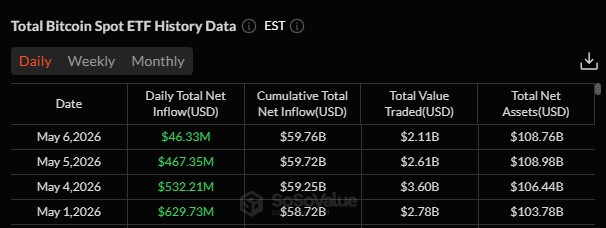
This continued ETF shopping for will make it troublesome to argue that Bitcoin is repeating its 2020 conduct as a pure liquidity supply.
Moreover, the political context has modified. The White Home’s assist for the Strategic Bitcoin Reserve has given Bitcoin a sovereign-level coverage narrative that didn’t exist in the course of the coronavirus crash.
Whereas this doesn’t assure a worth flooring, it does change the best way traders construction drawdowns.
Which means that Bitcoin is not a speculative asset traded exterior of conventional techniques. It’s now tied to discussions about public firm steadiness sheets, ETF portfolios, and government-level reserves.
That evolution is the core distinction between this scare and the pandemic crash six years in the past.
Prediction markets are displaying warning, not panic
Prediction markets additionally recommend that merchants are usually not pricing in a full-blown international well being shock and are being cautious.
In Polymarket, a contract asking whether or not there will likely be a “hantavirus pandemic in 2026” lately confirmed the likelihood to be near 9%. Carsi, a regulated US prediction market platform, confirmed a excessive likelihood of the WHO definitively characterizing the outbreak as a pandemic, at almost 35.7%.
This hole displays variations in contract language, market construction, and dealer base. It additionally reveals that concern buying and selling stays uneven.
Crypto-native speculators look like estimating the chance of a real pandemic to be low, whereas the broader occasion danger market locations extra weight on the WHO’s official language.
Nevertheless, the extra speculative components of cryptocurrencies are already shifting sooner than the potential dangers.
A number of hantavirus-themed tokens appeared on decentralized exchanges, one in all which reached a market worth of round $3.5 million inside hours.
That response speaks much less in regards to the illness and extra in regards to the consideration financial system of cryptocurrencies. When a worldwide headline emerges, the meme coin market is usually the primary to financialize it, no matter whether or not the underlying occasion has any lasting significance out there.
What’s going to decide Bitcoin’s subsequent transfer?
The following check for Bitcoin will likely be whether or not the $80,000 space holds as assist or turns into one other failed breakout.
The primary variable is a public well being time period. So long as WHO officers proceed to say the danger is low and linked to the cruise ship cluster, the macro impression ought to stay restricted.
However that calculus may rapidly change if there’s proof of sustained unfold past shut contacts.
The second is demand for ETFs. Constructive or impartial flows via a worsening headline cycle would point out that institutional traders are treating concern as noise reasonably than a purpose for exit. Nevertheless, the sharp reversal in ETF outflows could recommend the market is turning into extra defensive.
The third is affirmation from conventional markets. A real pandemic-style danger shock is more likely to manifest as a stronger greenback, decrease Treasury yields, greater volatility indicators, and general strain on equities.
Absent these strikes, Bitcoin’s pullback will look extra like localized profit-taking after a robust rally than the beginning of a broader liquidity break.
To this point, the hantavirus outbreak shouldn’t be a recurrence of the brand new coronavirus. It is a reminder that Bitcoin’s institutional maturity is most clearly judged when the catalyst comes from exterior the crypto area.
The $80,000 rally can overcome the subdued well being fears, however it might want to show that concern doesn’t transmit to the market with the identical pressure because it did in March 2020.