

The crypto {industry} frames quantum computing as a single, catastrophic “Q-Day” second when a sufficiently highly effective machine arrives, shatters outdated cryptographic keys, and unravels the historical past of blockchains. This week, that second could have been moved ahead to this decade.
The Ethereum Basis’s March 24 Submit-Quantum (PQ) Roadmap signifies that the true quantum menace to Ethereum facilities on solid signatures that allow theft and impersonation, and that the collection of stronger cryptographic algorithms is a comparatively manageable layer of this downside.
The coordination infrastructure beneath is orders of magnitude harder.
The EF FAQ ranks revealed surfaces in a selected order. Consumer accounts (externally owned accounts, or EOAs), change high-value operational keys, bridges, custody scorching wallets, governance and upgrades multisig, after which validator keys.
Every class has a distinct migration schedule and political weight. Collectively, they describe a reside monetary system that has lots of of thousands and thousands of accounts and must improve itself whereas operating at full capability, with no acceptable flag days.
Account abstraction is the first execution layer migration path for EF as a result of it permits customers to exchange ECDSA-based authentication with out forcing a reset of your entire chain.
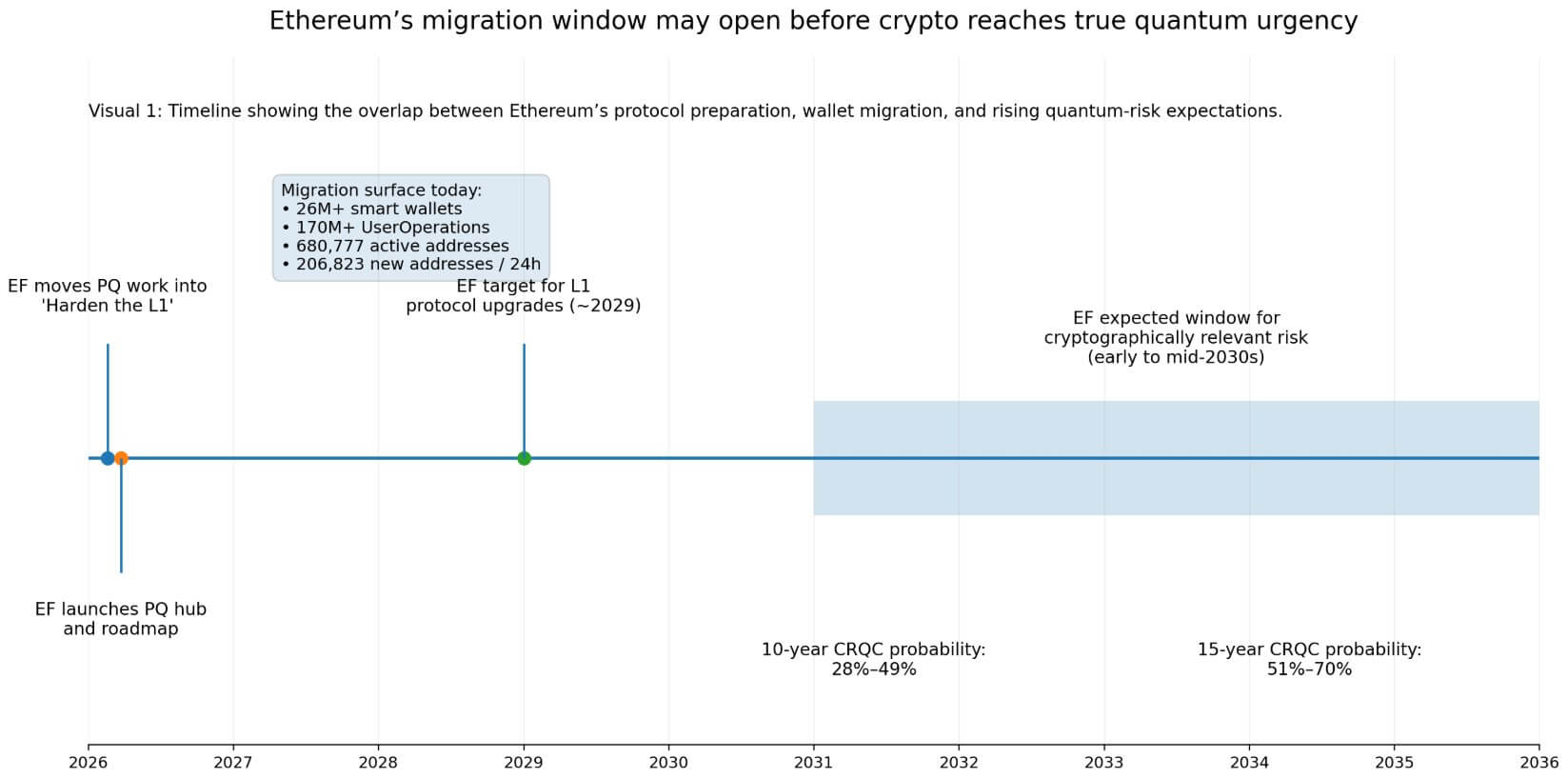
The EIP-4337 infrastructure already helps over 26 million sensible wallets and 170 million UserOperations, which is only a small portion of Ethereum’s lively person floor.
DefiLlama is at the moment displaying roughly 680,777 lively Ethereum addresses, together with 206,823 new addresses prior to now 24 hours.
The Basis’s timeline requires an L1 protocol improve in roughly 2029, with full migration of the execution layer taking a number of extra years. In response to EF, most specialists’ roadmaps place cryptography’s relevance within the early to mid-2030s.
The International Danger Institute’s 2025 Quantum Menace Survey places the chance of cryptographically related quantum computer systems showing inside 10 years at 28% to 49% and inside 15 years at 51% to 70%, with respondents noting that that timeline is accelerating.
The overlap between L1 preparation and person pockets migration is the place the operational threat actually lies.
Nevertheless, the schedule seems to be like will probably be robust this week. Google’s new warning will compress coverage and market timelines, even when the scientific proof stays unsure. Google is at the moment planning for Q-Day in 2029. Though it isn’t sure when quantum computer systems associated to cryptography will seem, the operational framework will change.
As main infrastructure operators begin budgeting and planning for shorter time horizons, post-quantum readiness will stop to be a distant analysis subject and change into a close-to-cycle execution downside for wallets, bridges, custodians, and validators.
The place capital and management are concentrated
Bridges and custody layers vastly enhance that threat.
L2Beat reveals that Ethereum-linked L2 has secured round $32.54 billion in worth, whereas DefiLlama reveals that Bridge protocols on Ethereum maintain round $7.275 billion in complete worth locked, with BridgeRail processing round $18.835 billion in quantity final month.
These flows cross by a comparatively compact set of key administration choke factors, the very “high-value operational keys” that EF locations second in its threat hierarchy.
TRM Labs’ January 2026 Crime Report discovered that infrastructure assaults in opposition to keys, wallets, and entry management techniques accounted for almost all of the $2.87 billion in cryptocurrency hacking losses in 2025, surpassing sensible contract abuse.
The operational self-discipline required by the post-quantum roadmap on this area displays the self-discipline that right this moment’s {industry} is already failing, which is why the rotation of bridge and custody keys is urgently occurring on two timelines concurrently.
The validator layer provides one other dimension to the reconciliation downside.
Beaconcha.in reveals roughly 976,204 lively validators and 36.67 million ETH staked, which at first look seems to be a maximally decentralized key migration downside.
On the entity stage, Lido holds 21.24% of the web staking share, Binance 8.73%, Ether.fi 6.05%, and Coinbase 4.64%, giving these 4 operators a mixed management of roughly 40.66%.
Validator key rotation is each a mass coordination downside and an operator focus downside.
| floor | Essential standing | why is it essential | Kind of threat | Migration challenges |
|---|---|---|---|---|
| Consumer account/EOA | 680,777 lively addresses. 206,823 new / 24 hours | largest reside floor | Theft/Impersonation | Per-user migration |
| sensible pockets rail | Over 26 million sensible wallets. 170+ million person operations | Current migration path | uneven recruitment | UX + pockets instruments |
| bridge | TVL $7.275 billion. Month-to-month buying and selling quantity $18.835 billion | Worth is concentrated in a small set of keys | Operational key compromise | Speedy group rotation required |
| L2 linked to Ethereum | Secured a worth of $32.54 billion | Massive capital stacks depend on infrastructure | Oblique ecosystem spillover | Coordination between techniques |
| validator | 976,204 folks lively. Staking 36.67 million ETH | Enormous validator set | Community operation dangers | Massive-scale, intensive operator migration |
| Prime staking entities | Lido 21.24%, Binance 8.73%, Ether.fi 6.05%, Coinbase 4.64% | Prime 4 controls complete 40.66% | Operator focus | The chief units the tempo |
When main staking platforms rotate their keys early, migration momentum naturally builds and smaller validator cohorts observe a transparent precedent. When massive operators maintain again, the burden of compliance falls disproportionately on impartial validators, who lack the operational infrastructure to face alone.
EF is assembling a dormant coin purse as probably the most political component of its roadmap.
Accounts which have by no means revealed their public keys is not going to be uncovered to direct quantum publicity, because the keys will stay hidden inside their addresses.
Accounts that make transactions, publish their public keys, after which go silent are a wholly totally different class, leaving their funds susceptible with no self-migration mechanism.
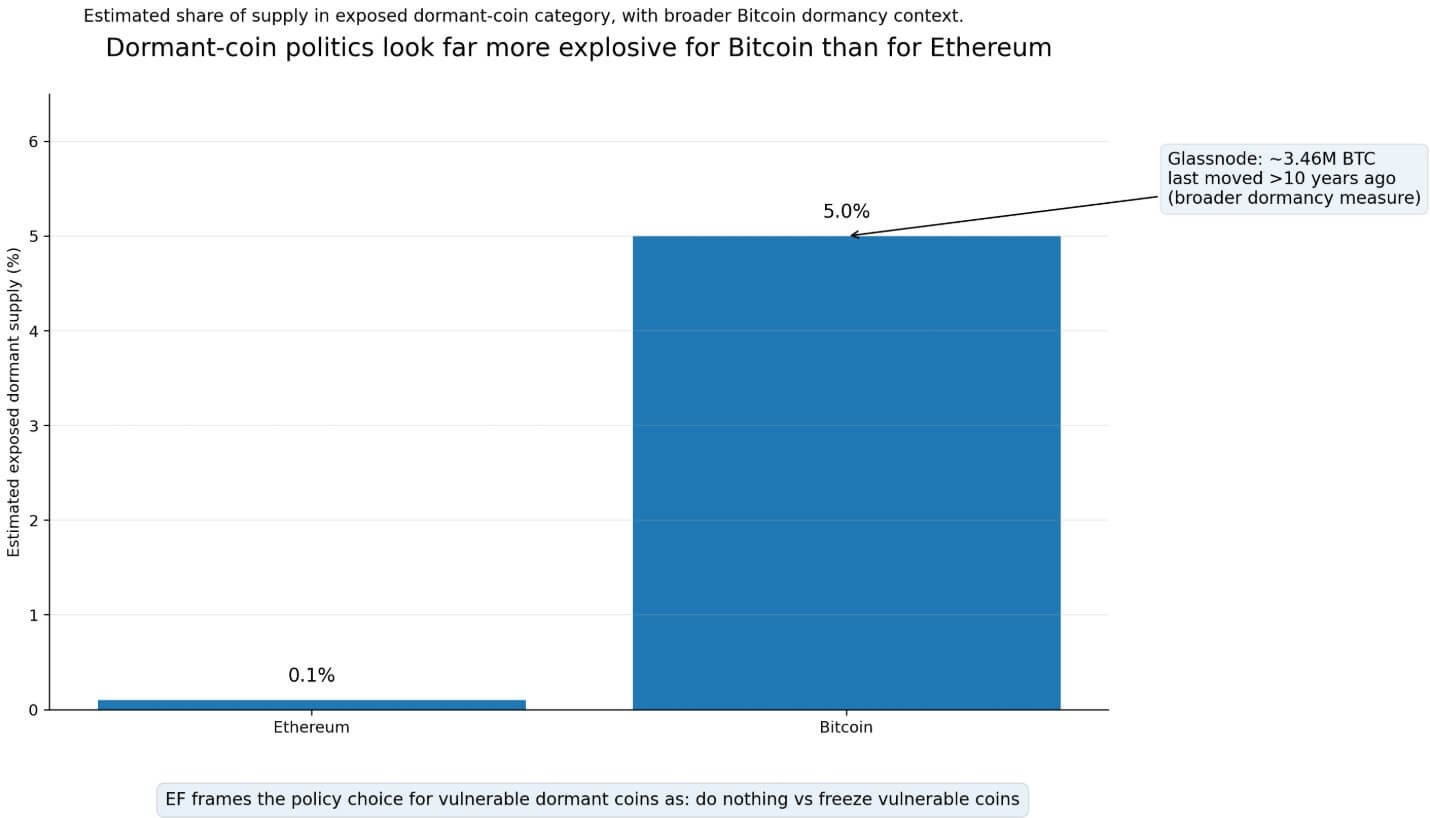
EF’s FAQ lists two pure outcomes when the danger window arrives. Both do nothing or freeze susceptible cash. EF explicitly frames its selections as group governance selections, requiring social settlement about who can be protected and beneath what circumstances.
EF estimates that Ethereum’s publicity on this class is round 0.1% of provide and Bitcoin’s publicity is nearer to five%, however that is associated to an early handle format that many imagine has been deserted.
Justin Saylor of a16z argued that Bitcoin is uniquely uncovered as a result of early P2PK outputs put public keys straight on-chain, and Bitcoin’s governance construction makes freezing preparations politically stringent.
Glassnode reveals that roughly 3.46 million BTC has been inactive for greater than a decade, a widespread dormancy motion that reveals why the controversy over dormant cash is way more flammable for Bitcoin than for Ethereum.
2 outcomes
Ethereum is predicated on an account abstraction infrastructure that’s already operating at scale.
If the EIP-7702 and EIP-4337 instruments permit a big portion of lively customers emigrate earlier than quantum nervousness reaches a retail tipping level, Ethereum can take in the transition with out triggering a governance disaster.
Bridges and custodians handle concentrated worth, face organizational due diligence calls for, transfer first, and set up industry-wide transition norms.
As a consequence of Ethereum’s low dormancy publicity numbers, a coverage of “doing nothing” stays politically viable and will keep away from a contentious debate over freezing Ethereum.
The actual benefit of Ethereum in that state of affairs is its improve agility. In different phrases, a reside monetary system that’s quantum-ready by a phased, incentive-aligned transition that maintains continuity and person expertise throughout the board.
Nevertheless, if the L1 milestone declines, the execution layer transition can be deeper into the 2030s, and the very best worth floor will stay partially anchored in conventional assumptions because the quantum timeline tightens. That is very true if Google’s 2029 predictions come true.
As infrastructure assaults now account for many of the hacking losses, the market is beginning to think about operational delays as a safety low cost for directors and bridge operators earlier than quantum computer systems change into a actuality.
Submit-quantum readiness will change into an ordinary due diligence commonplace for institutional buyers, and operators that can’t reveal a dependable transition schedule will face capital outflows and better insurance coverage prices.
Encryption threats are pushed by market perceptions of operational delays which can be a lot sooner than the encryption occasion, inflicting reputational and capital prices to build up in the course of the transition window itself.
In February, EF positioned its PQ work inside the “Hardening L1” protocol monitor, explicitly linking native account abstraction to quantum readiness. Encryption proceeds on a predictable schedule.
Immigration battles over wallets, bridges, and dormant cash have already begun.