



On-chain charges paid by customers within the first half of 2025 had been $9.7 billion, a rise of 41% year-over-year and the second highest complete on report.
1kx predicts on-chain charges will exceed $32 billion in 2026 as a result of accelerating software progress. This progress has made the phrase “income” part of each crypto investor pitch deck, each sector report, and each valuation dialog.
The report added that Bitcoin’s drawdown may lead to a stress check for protocol charges.
1kx’s April sector evaluation discovered that almost all cryptocurrency payment classes are positively correlated with BTC worth. There’s additionally extensive variation throughout sectors, and the important thing variables of draw back beta are nonetheless unresolved.
The corporate notes {that a} 0.6 correlation means very various things relying on whether or not sector charges fall at 0.8x or 1.5x the tempo of Bitcoin, and that the sensitivities of up and down charges could be decomposed and recognized.

In cryptocurrencies, payment traces can appear like bull market enterprise however commerce like amplified BTC beta when macro fears arrive.
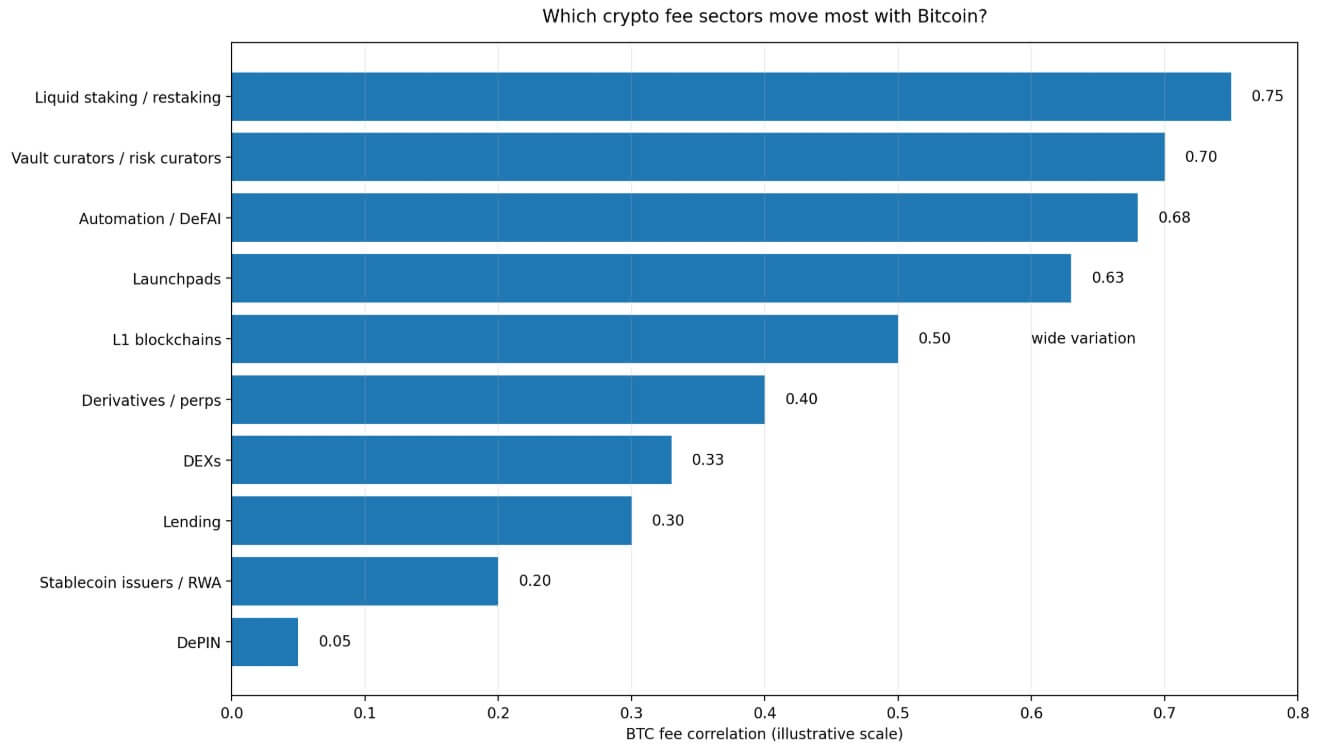
reflexive worth cluster
The sectors that 1kx has recognized as most correlated with Bitcoin worth share a typical financial construction that improves as costs rise and worsens as costs fall, usually quicker than the underlying asset itself.
Liquid staking and restaking sit on the high of that cluster, with payment streams depending on yields that develop as borrowed capital and danger urge for food expands, and contract as they retreat.
Vault curators face comparable temptations, as property stream in when worth momentum is constructive and property stream out when sentiment reverses. Launchpad is probably the most sentiment-driven class within the report, with launch exercise accelerating when there’s a bullish pattern and stalling when confidence collapses.
Automation protocols and DeFAI protocols that earn charges associated to transaction exercise and technique deployment additionally monitor the identical directional pulse.
In keeping with 1kx, the correlation of charges to BTC for Layer 1 (L1) blockchains varies extensively, with many inheriting market course by way of the value actions and exercise mixture of their native tokens, whereas others exhibit extra independence relying on their software base.
This volatility implies that most L1s nonetheless retain significant BTC sensitivity to the payment line as a result of directional will increase within the token worth in on-chain exercise.
Reflexivity unites these classes, as these charges are primarily the product of the identical speculative, position-driven exercise that powers Bitcoin itself.
When buyers speak about rising charges in these sectors when markets are up, they’re partly explaining enterprise momentum and partly the identical macro tailwinds which have pushed up all danger property of their portfolios.
Service layer offered
DePIN stands out because the lowest correlation class inside 1kx’s framework and is distinguished as a standout for non-directional crypto income publicity.
The reason being that DePIN charges monitor the quantity of compute, bandwidth, storage, and different companies offered. Demand for these companies comes from customers with actual operational wants, and whereas token costs affect the inducement construction, they don’t instantly set fee charges the best way asset costs do for yields and beginning exercise.
1kx initiatives DePIN charges to exceed $450 million in 2026 and keep triple-digit progress.
Stablecoin issuers and real-world asset protocols equally sit within the low correlation vary, with 1kx estimating their BTC correlation to be round 0.2. The economics of their charges rely closely on issuance, reserve administration, and property beneath administration, in addition to speculative buying and selling.
A low correlation signifies that the payment construction isn’t very tied to the course of BTC worth. 1kx’s framework helps “extra differentiated return publicity” and is way from claiming immunity from declines.
A extra correct argument is that companies linked to DePIN and issuance have a greater structural foundation for defending the payment line throughout BTC-specific drawdowns.
| sector group | essential payment driver | Motion in a rising market | Doable stress throughout drawdown | Article excerpt |
|---|---|---|---|---|
| Liquid staking/re-staking | Yield, leverage, danger urge for food | Costs develop quickly | Compression happens and exercise weakens | most reflective |
| Vault Curator | AUM, momentum, inflows | AUM will increase with worth | Outflows might happen quicker than BTC | Excessive draw back sensitivity danger |
| launchpad | feelings, begin an exercise | Robust in bullish conditions | Boot quantity might cease quickly | Extremely cyclical |
| Automation / DeFAI | Technique growth, buying and selling actions | Profit from an lively market | Danger urge for food might scale back utilization | Directional payment publicity |
| Depin | Compute, bandwidth and storage calls for | Progress primarily based on service utilization | Extra safety from BTC-specific shocks | probably the most differentiated |
| Stablecoin / RWA | Issuance quantity, reserves, stability of property beneath administration | slower progress | Indirectly associated to BTC actions | Decrease correlated payment publicity |
| DEX / Financing / PERP | Quantity, charge, volatility, leverage | can profit from the exercise | combination. Volatility helps, however lessens the ache | A contested center floor |
Decentralized exchanges (DEXs), lending protocols, and perpetual platforms occupy a contentious center floor. At 1kx, the median DEX correlation is round 0.33, loans round 0.3, whereas derivatives present massive fluctuations, exceeding 0.4 in some instances.
Volatility helps buying and selling volumes even in down markets, offering a partial buffer for these sectors. Nonetheless, compression of fee charges and leisure of positions throughout stress episodes makes the return line extra risky than easy common correlation can seize.
Why is valuation actually worthwhile?
1kx’s in depth earnings report exhibits that price-to-fee ratios throughout the crypto sector span orders of magnitude. The median P/F ratio for blockchain in Q3 2025 was 3,902x, in comparison with round 7,300x for L1 and 17x for DeFi and finance.
DePIN’s median P/F ratio fell to 211x from roughly 1,000x within the year-ago interval. Despite the fact that DeFi and finance generate nearly all of charges, blockchain valuation nonetheless accounts for over 90% of the analyzed fee-generating market capitalization.
1kx additionally notes that adjustments in charges will drive valuations in DeFi, finance, and to a lesser extent blockchain.
If this directional relationship stays downward, with charges initially declining and multiples compressing within the weeks following the preliminary worth transfer, a BTC drawdown exposing payment vulnerabilities in extremely correlated sectors may set off a secondary valuation correction.
Buyers who had assigned a Enterprise High quality score to a Beta revealed payment stream will now face speedy worth adjustments.
check is postponed
If the macro surroundings continues to ease, together with falling oil costs, sustained expectations for Fed charge cuts, and declining geopolitical dangers, Bitcoin may stay stable within the mid-to-high $70,000s and transfer towards Citi’s 12-month benchmark goal of $112,000.
In that surroundings, payment traces for many sectors will proceed to widen and draw back beta will stay theoretical. 1kx predicts that application-driven payment progress will speed up by way of 2026, with DeFi and finance increasing by greater than 50% yr over yr.
The chance on this state of affairs is that the market continues to deal with periodic robust payment progress as proof of sustained enterprise high quality. Launchpad exercise stays excessive in a buoyant market, restaking yields look stable when danger urge for food is wholesome, and Vault curators are reporting excessive AUM numbers.
Audits are postponed and capital continues to stream into sectors the place the standard of charges has by no means been examined beneath actual stress. The surroundings of falling oil costs, easing inflation issues, and a resurgence of bets that the Fed will reduce rates of interest is strictly the type of surroundings during which that postponement will enhance.
February repeats on a grand scale
On February 5, Bitcoin fell 14.1% in a single session to an intraday low of $62,254.50 as danger sentiment weakened, tech shares bought off, and ETF outflows accelerated.
Throughout this episode, the cryptocurrency market misplaced about $2 trillion from its October peak. Launchpad exercise has cooled, debt capital positions have been unwound and restaking yields have been compressed.
The value line, which was spectacular till the top of 2025, confirmed directional dependence inside a number of weeks.
If this sample repeats, questions on draw back beta will transfer from the subsequent step acknowledged by 1kx to a dwell market occasion.
Sectors with reflexive payment constructions will face probably the most scrutiny. The market is searching for a launchpad, we’re seeing a decline in launch volumes, re-staking yields are compressed as borrowed capital exits, and vault curators are seeing AUM fall quicker than token costs.
Companies associated to DePIN and issuance will nonetheless face headwinds, however for the primary time the relative payment resilience will turn out to be discernible within the knowledge.
The identical mechanism works in reverse when DeFi and monetary valuations enhance as a result of payment adjustments.
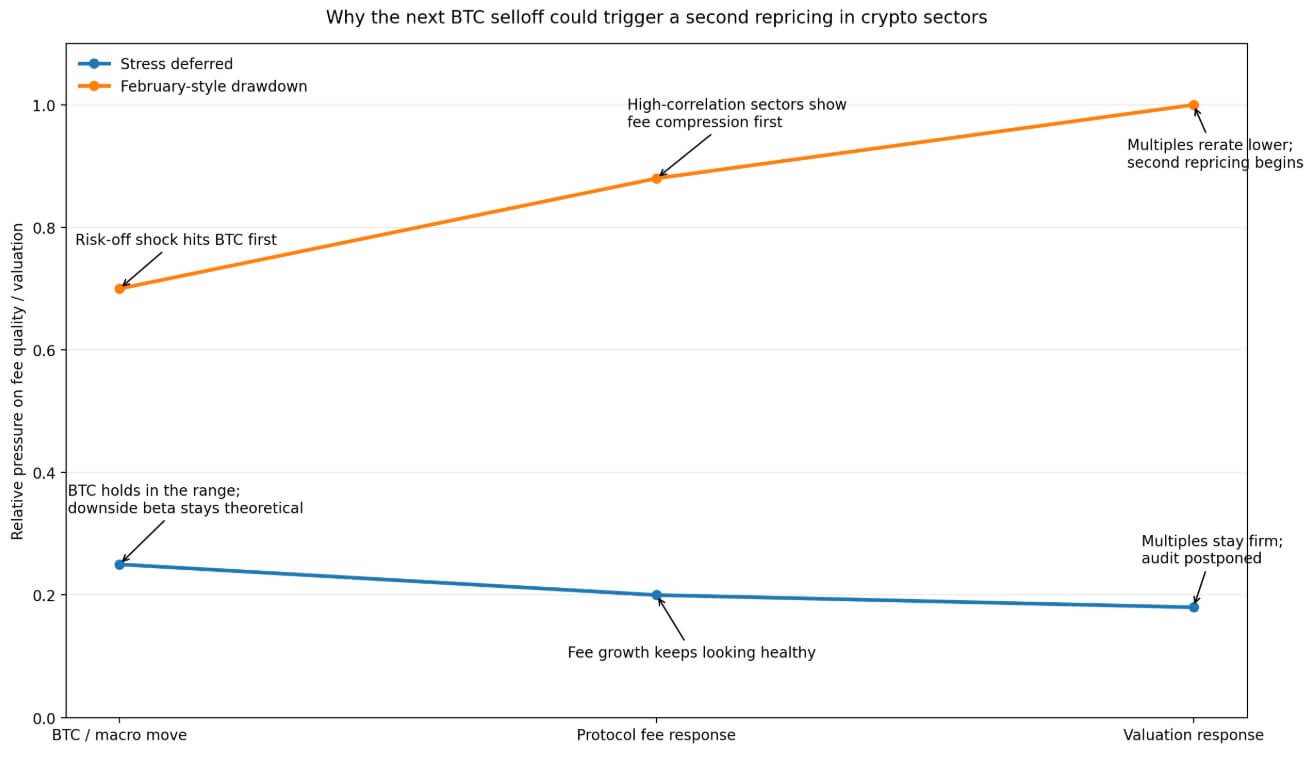
Protocols that report payment compression within the first quarter of the subsequent down cycle give the market a cause to compress charges earlier than the general image is resolved.
Buyers who had assigned a Enterprise High quality score to a Beta revealed payment stream will now face speedy worth adjustments.
Bitcoin presently sits at round $78,000, close to the highest of its current vary from April’s geopolitical reduction rally, exactly through the interval when the standard of charges problem stays unresolved.