



The Ethereum Basis (EF) introduced on April eighth that it’ll convert 5,000 ETH right into a stablecoin by CoWSwap’s TWAP characteristic to fund analysis, grants, and donations.
This announcement reignited the controversy over the aim of the Basis’s monetary overhaul. Final 12 months, EF moved its monetary property to DeFi, borrowed utilizing ETH as collateral, after which started a staking initiative centered on round 70,000 ETH.
The fact outlined within the EF’s June 2025 monetary coverage suggests a distinct mannequin. It tied monetization to a fiat-denominated operational buffer, maintaining ETH gross sales, staking, and stablecoin borrowing throughout the similar Treasury framework.
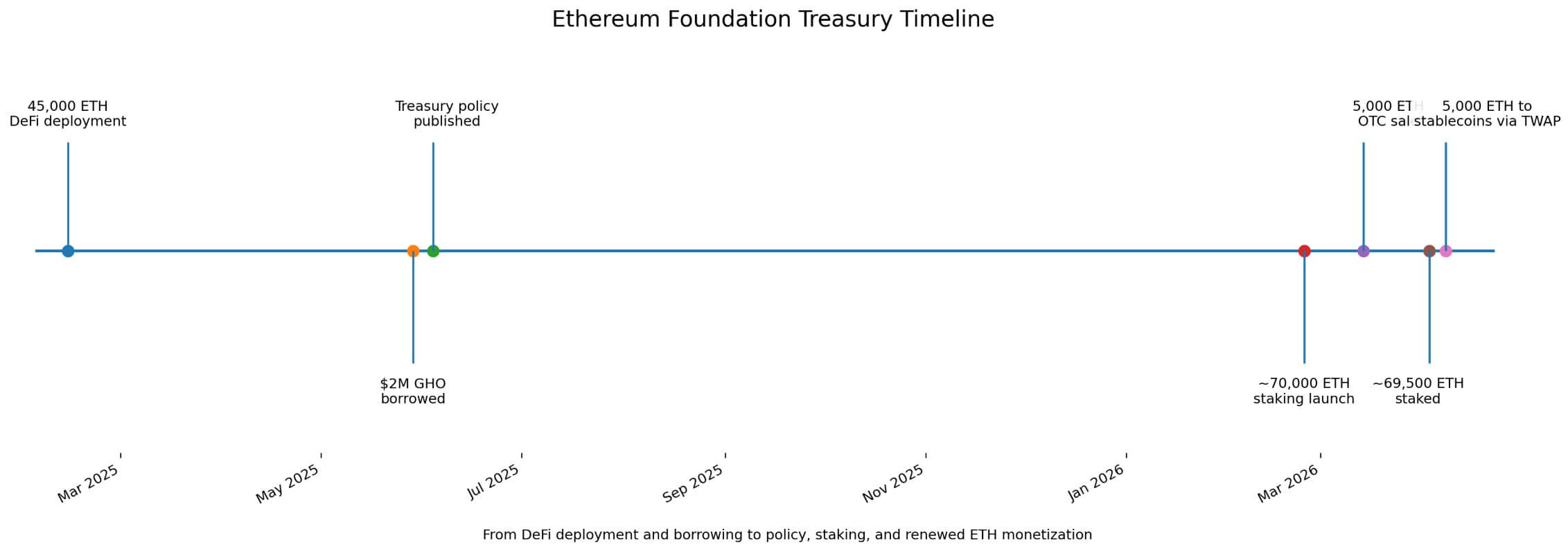
On February 13, 2025, the EF Treasury introduced that it had deployed 45,000 ETH throughout Spark, Aave Prime, Aave Core, and Compound. On Might 29, the corporate borrowed $2 million in GHO for its Aave place.
This transfer had symbolic weight because it confirmed that EF was utilizing DeFi rails to boost working capital with out promoting spot ETH.
By early April, that interpretation had permeated the retail dialog, with a Reddit submit claiming that EF was “not promoting.” One commenter replied, “I am glad they stopped promoting it.”
Regardless of the anecdotal proof, this type of chatter exhibits how a stronger model of the paper was already in circulation earlier than EF introduced its April 8 swap.
Gross sales are ongoing
EF launched its staking initiative on February twenty fourth, saying that it could stake 70,000 ETH and the rewards can be returned to the Treasury.
On March 14th, we accomplished a 5,000 ETH OTC sale to BitMine at a median value of $2,042.96. On April third, on-chain exercise introduced the whole quantity of staking to roughly 69,500 ETH, transferring us nearer to our objective. Then got here the CoWSwap transformation on April eighth, highlighting that promoting and staking have already been working in parallel for a number of weeks.
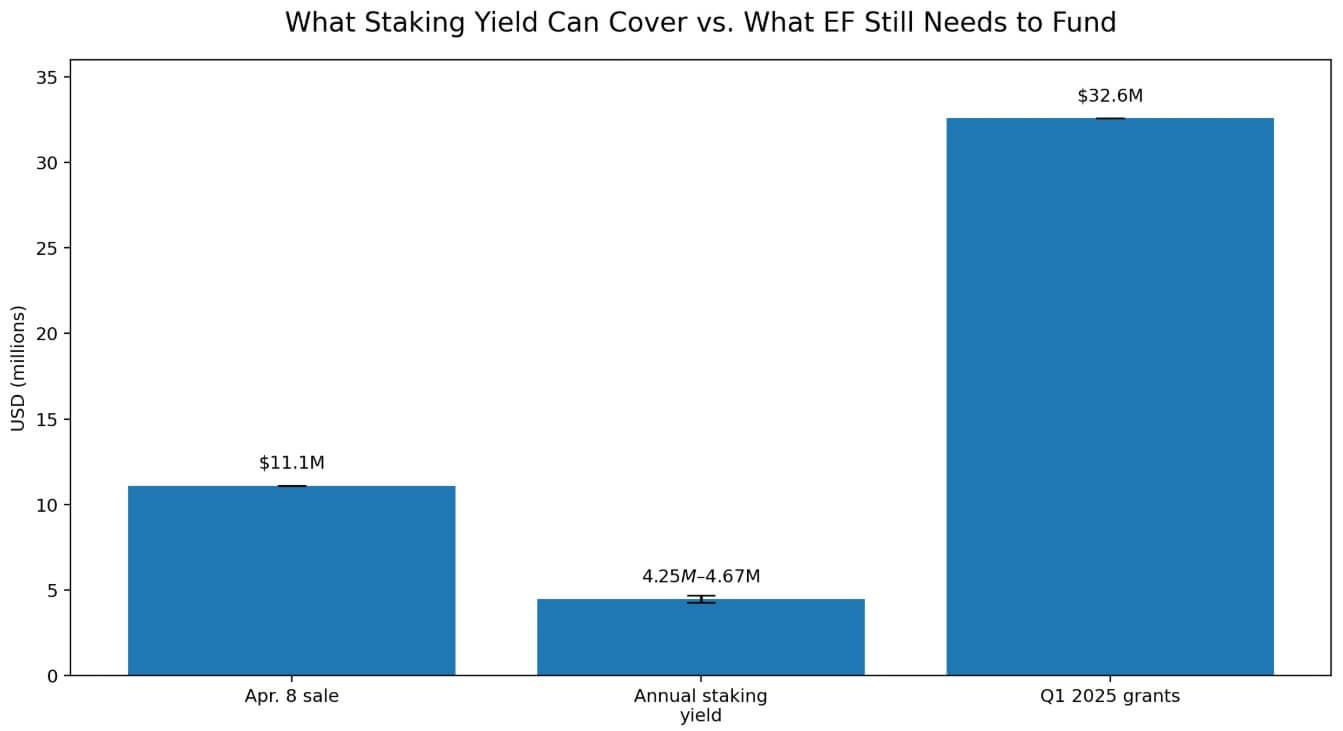
At an ETH value of roughly $2,220.76, 5,000 ETH equal to roughly $11.1 million, the ETH staking normal fee at the start of April was hovering round 2.73% to three.00%.
70,000 ETH, producing roughly 1,912 to 2,102 ETH per 12 months, equal to roughly $4.25 million to $4.67 million at present costs. One 5,000 ETH sale corresponds to roughly 2.4-2.6x annual yield from your entire 70,000 ETH staking sleeve.

Whereas staking applications enhance treasury effectivity and scale back funding necessities, they continue to be nicely under the dimensions wanted to interchange treasury gross sales.
The EF’s June 2025 framework units annual working prices at 15% of the Treasury and an working buffer of two.5 years, which means fiat reserves equal to 37.5% of the Treasury.
The October 31, 2024 report, which applies solely by the use of instance to EF’s final total monetary snapshot, exhibits whole treasury of $970.2 million and non-crypto property of $181.5 million, suggesting coverage goal reserves of roughly $363.8 million.
EF has already publicly added to its stablecoin publicity after that snapshot, deploying 2,400 ETH and roughly $6 million in stablecoins to Morpho in October 2025, and subsequently saying extra ETH to stablecoin conversions in October 2025 and April 2026.
The present precise measurement of EF’s fiat-like bucket and whether or not tokenized RWA holdings have already been added to the fabric measurement remains to be unknown. Due to this fact, the 2024 snapshot ought to nonetheless be handled as illustrative fairly than an alternative choice to immediately’s steadiness sheet.
EF’s personal allocation replace confirmed the grant for the primary quarter of 2025 at $32.6 million. At immediately’s ETH value, that is equal to roughly 14,700 ETH. The April 8 diversion covers solely about 33% of whole grants for the quarter, excluding protocol analysis, staffing, operations and broader business assist.
Yields and borrowings go away you with a fiat-denominated price range, however it nonetheless requires common monetization.
potential penalties
The bullish case for EF is predicated on easy arithmetic from Treasury, as rising ETH costs and decrease long-term funding ratios permit the inspiration to take care of greenback buffers whereas monetizing fewer cash.
| situation | what is going to change | In all probability the Treasury impact |
|---|---|---|
| bull case | ETH value rises, long-term funding ratio declines | Fewer cash have to be bought to take care of fiat buffers |
| primary case | Blended technique continues | Staking, DeFi, borrowing, and common gross sales coexist |
| bear case | ETH value falls, spending stress will increase | Extra ETH might have to be monetized to take care of runway |
| necessary which means | Reserve targets proceed to be denominated in fiat currencies | When ETH falls, the story of “few gross sales” collapses. |
In that setting, staking rewards and selective borrowing may scale back quarterly gross sales and provides EF extra flexibility in venue choice, whether or not by OTC blocks, TWAP execution, or conservative DeFi positions.
Then the modernization of the Treasury will seem as a decrease cadence, a smaller clip and higher execution.
For the reason that EF’s reserve targets are denominated in fiat currencies, the bearish case passes by the identical framework in reverse.
If ETH costs fall, foundations could also be compelled to additional monetize to take care of runway, particularly in the event that they lean towards a counter-cyclical mission and spend extra aggressively in more durable market situations.
On this setup, a big staking sleeve will nonetheless generate yield, however reserve necessities might rise quicker than offsetting that yield.
Public expectations constructed round “much less promoting” would conflict with the steadiness sheet self-discipline that the EF had already factored into its coverage.
With the conversion of April 8, the self-discipline was introduced again into view. EF’s monetary technique already mixed DeFi deployment, stablecoin borrowing, staking, and common ETH gross sales.
The market story prolonged past written insurance policies and past the inspiration’s personal post-staking transaction data.