



Bitmine has over $10 billion staked in ETH, making it the most important company Ethereum treasury firm and a yield-generating wager on the community’s proof-of-stake financial system.
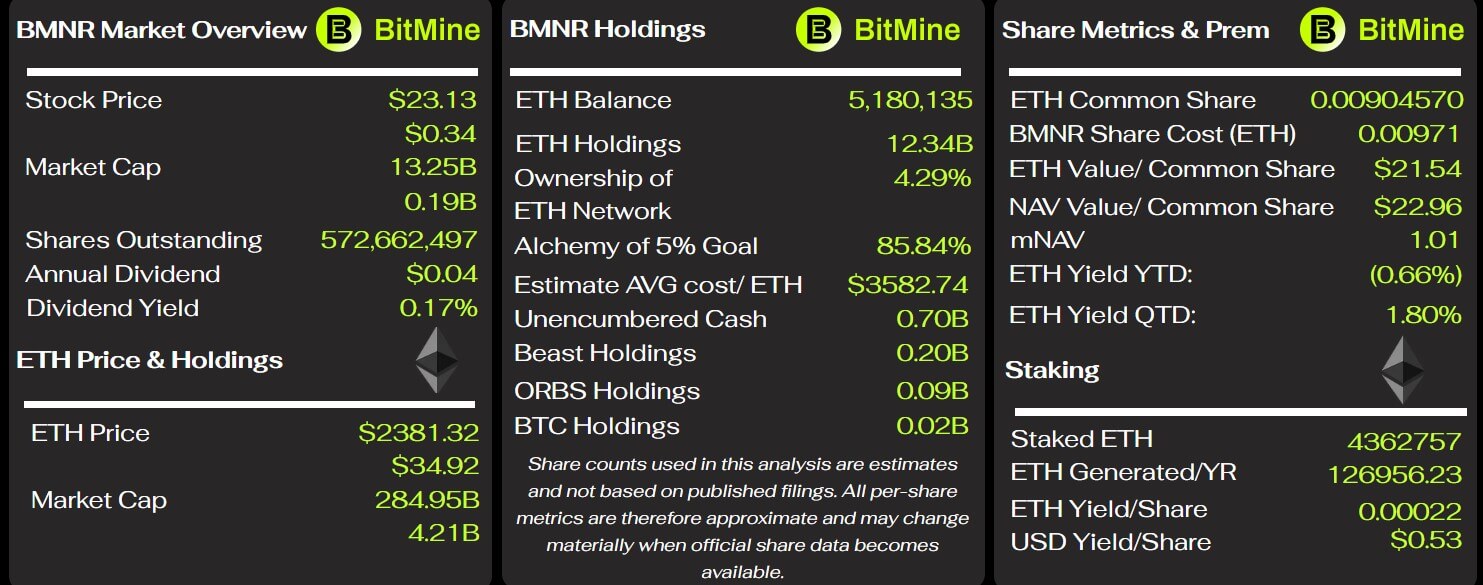
On Might 4, the Las Vegas-based firm introduced that its ETH place was 4.36 million tokens, price $10.2 billion at a median ETH value of $2,336.
This place represents over 84% of BitMine’s whole ETH holdings, giving the corporate one of many largest seen company exposures to Ethereum’s verification system.
BitMine mentioned it held 5.18 million ETH as of Might 3, representing about 4.29% of the whole Ethereum provide. The corporate additionally reported 200 Bitcoin, $700 million in money, an funding in Beast Industries, and shares in Eightco Holdings, bringing its whole holdings in cryptocurrencies, money, and “moonshots” to $13.1 billion.
Betting on Ethereum vaults turns into a staking enterprise
BitMine mentioned its staking operations generate roughly $297 million in annual income based mostly on a seven-day annualized fee of return of two.91%.
Chairman Thomas “Tom” Lee mentioned that when the corporate’s ETH holdings are totally staked by MAVAN, the Made in America Validator Community, and different staking companions, the anticipated annual staking rewards may attain $352 million.
With this disclosure, BitMine’s Ethereum technique strikes from steadiness sheet accumulation to testing recurring income.
Public corporations primarily use Bitcoin as a monetary reserve asset, with Michael Saylor’s technique setting the template for company accumulation. Ethereum provides BitMine a unique construction as you may stake belongings instantly into the community and earn protocol rewards.
BitMine’s measurement makes it an open market company for Ethereum’s staking financial system. Traders in BMNR inventory are not solely uncovered to fluctuations out there value of ETH. They’re additionally uncovered to the corporate’s capability to handle its validator infrastructure, earn community rewards, and enhance Ethereum’s standing over time.
Specifically, as of Might 1, BMNR has recorded a median each day buying and selling quantity of $625 million over 5 days, rating 173rd amongst U.S.-listed shares.
This liquidity provides the corporate a public fairness channel the place buyers can voice their opinions on Ethereum accumulation and staking with out instantly proudly owning the tokens.
Ethereum validator queue exhibits widespread demand
BitMine’s staking push comes as Ethereum’s validator entry queue is quickly growing, indicating renewed demand for ETH as a yield-producing asset, even because the token’s value story stays contested.
In keeping with ValidatorQueue knowledge, roughly 3.72 million ETH is ready to affix the validator set, with activation delays estimated to be over 64 days. Roughly 346,000 Ethereum are ready for exit, and the wait time is estimated to be roughly 6 days.
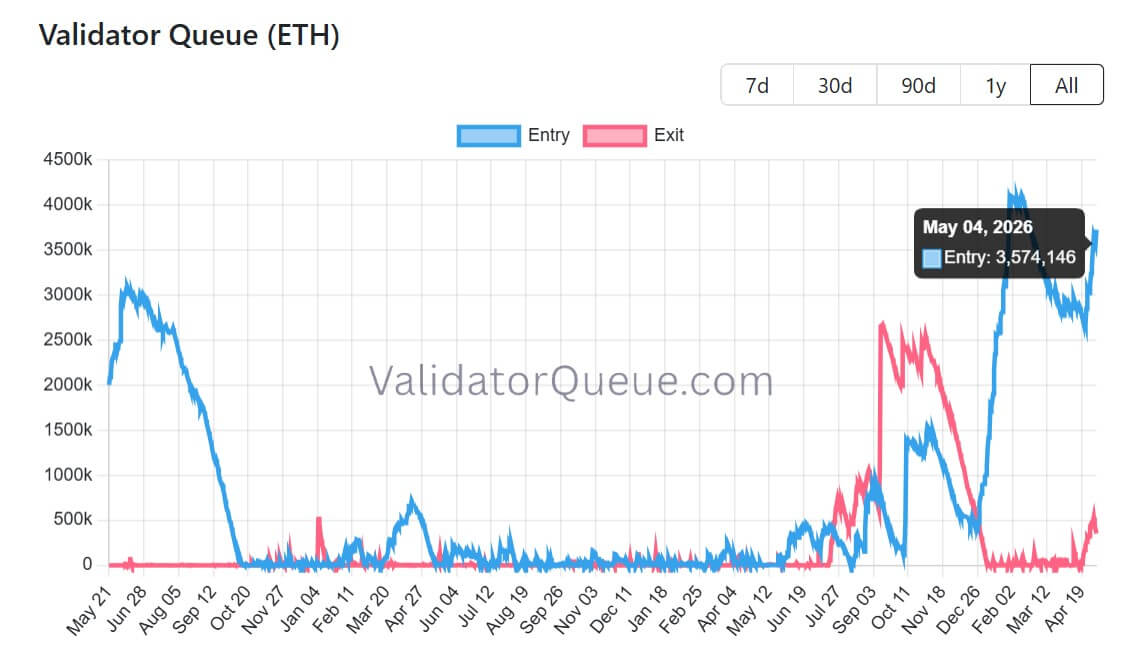
The community had roughly 898,000 lively validators with 38.6 million ETH staked, and the staking fee was roughly 31.7% of provide.
Ethereum limits the quantity of ETH that may enter and exit validation at anyone time by a churn mechanism designed to guard the steadiness of consensus. This throttling can create lengthy queues if new deposits can exceed the speed at which validators might be activated.
Then again, a queue doesn’t imply that every one of that ETH has already earned rewards. Deposited Ethereum should watch for activation earlier than it might probably start taking part in validation.
Nonetheless, the imbalance between entry and exit queues signifies that extra capital is attempting to enter Ethereum staking than goes out.
This can be a noteworthy sign for the Ethereum market. Whereas a bigger staking base can shortly scale back liquid provide, validator rewards flip ETH right into a productive asset for holders prepared to simply accept lock-ups, technical and operational dangers.
Yield comes with operational threat
Ethereum staking differs from crypto lending as a result of rewards come from the protocol quite than from the borrower.
Validators lock ETH as collateral, run software program, certify blocks, and make sure the safety of the community. In the event you do it proper, you may earn rewards, however in the event you go offline you may lose them. In additional severe instances, validators might be penalized by a slash for dangerous habits.
Whereas this construction makes staking engaging to establishments searching for native crypto yield, it additionally creates a brand new class of operational threat for public corporations.
It’s because company ETH holders staking at scale want to manage validator uptime, shopper choice, custody, key administration, and publicity to staking companions.
For BitMine, the income alternative is evident. A 2.91% annual staking yield on billions of {dollars} of Ethereum creates a major earnings stream. Nevertheless, the danger is that staking is just not passive, not like holding Spot Ether in a company pockets.
The corporate’s MAVAN infrastructure is central to that technique. If BitMine continues to stake a big portion of its Ethereum, its monetary mannequin will rely not solely on the value of ETH, but in addition on the efficiency of its validators and the way reliably they will generate staking rewards throughout market cycles.
As such, BitMine’s mannequin is completely different from conventional crypto corporations. We maintain ETH and discover the opportunity of buying digital belongings and growing our share of the asset over time by protocol rewards.
Possession is completely different from management
Moreover, BitMine’s staggering ETH holdings additionally increase extra exact questions concerning the decentralization of blockchain networks.
In Ethereum’s proof-of-stake system, validators stake Ethereum into the community and take part in consensus.
In keeping with Ethereum.org, an attacker can intrude with finality in the event that they maintain greater than 33% of the staked Ether, and the upper the brink, the larger the danger. Finality relies on a two-thirds supermajority vote of the Ether staked on the checkpoint.
So whereas BitMine’s 4.29% share of the whole ETH provide is economically vital, it alone doesn’t grant it management over Ethereum.
Contemplating this, the extra related questions are how a lot ETH BitMine management is actively staked, whether or not the stake is distributed throughout operators and shoppers, and the way a lot of the community relies on a small group of institutional validators.
Discussions about Ethereum decentralization have lengthy targeted on staking concentrations, liquid staking protocols, centralized exchanges, and shopper variety. Massive swimming pools and staking suppliers can affect the community as they manipulate validators, form defaults, and orchestrate upgrades.
The arrival of BitMine provides a brand new company layer to that dialogue. Public corporations staking billions of {dollars} of Ethereum can enhance the safety of ETH by growing the worth locked in verification.
Nevertheless, issues may additionally enhance because the share of validator privileges will increase and turns into concentrated amongst a restricted variety of operators, custodians, or software program shoppers.
Public markets check Ethereum’s staking economics
The query for the market is whether or not BitMine’s technique will probably be handled as leveraged ETH buying and selling, as a staking earnings car, or as a hybrid of each.
As Ethereum rises, the monetary worth of corporations will increase. If the staking yield is secure, BitMine can generate rewards denominated in ETH regularly. If validator queues stay elevated, new entrants might have to attend longer to earn rewards, additional growing the worth of an organization’s preliminary staking measurement.
On the similar time, the other dangers are additionally clear. A fall within the ETH value may quickly scale back the greenback worth of the treasury.
As extra Ethereum enters the validation course of, staking yields might lower. Income methods can change into a supply of loss as a result of operational errors, companion focus, or shopper failure.
For Ethereum, the Bitmine transfer exhibits how proof-of-stake has modified the function of belongings in public markets. ETH is not held solely as a speculative token or reserve asset.
At BitMine’s scale, additionally it is getting used as productive capital that may generate income, safe the community, and reshape the controversy round institutional participation.