

A current paper by the Bitcoin Coverage Institute on Taiwan begins with the acquainted argument that the nation’s international change reserves are overly concentrated within the greenback. Gold is under its potential and Bitcoin might complement each.
Readers who cease there’ll miss the extra necessary arguments buried throughout the blockade and invasion framework of pages 5 to seven. There, the paper makes an attempt to redefine the causes of reserve asset failure.
Conventional reserve evaluation judges property based mostly on liquidity, worth stability, and credit score high quality. BPI’s paper provides a fourth take a look at. Can property nonetheless be moved, consumed, and mobilized if a sea route is blocked, a bunch nation withdraws storage entry, or one other state turns into politically hostile?
By that measure, gold can keep, greenback reserves can turn out to be conditional, and Bitcoin can stay electronically moveable no matter bodily entry or diplomatic standing.
It is a greater conceptual transfer than claiming Taiwan’s BTC place.
Why that is necessary: This marks a shift from conventional reserve considering. Property comparable to authorities bonds and gold, whereas remaining precious on paper, can turn out to be tough or inconceivable to make use of underneath sanctions, battle, or political stress. If reserve managers begin prioritizing entry over stability, Bitcoin will enter the dialogue as an emergency asset reasonably than a return play.
From macrobets to sovereign insurance coverage
For years, state-level Bitcoin discussions have moved alongside a single path: hedge towards forex depreciation, diversify reserves, and seize upside from adoption momentum.
This argument nonetheless seems in BPI papers, significantly in its pages on U.S. debt accumulation and the growth of the Federal Reserve’s stability sheet. A extra authentic contribution lies elsewhere, with the paper rating reserves by whether or not they’re accessible underneath duress.
Governments merely want to simply accept that the Treasury, correspondent banking networks, bodily saved metals, and international authorities debt have totally different dependencies.
Coverage questions concentrate on which property stay accessible if administration, transportation, or host nation politics go awry.
Official reserve actions have already confirmed that the framing extends far past Bitcoin supporters. In accordance with a report by the IMF, whole worldwide reserves, together with gold, reached SDR 12.5 trillion on the finish of 2024.
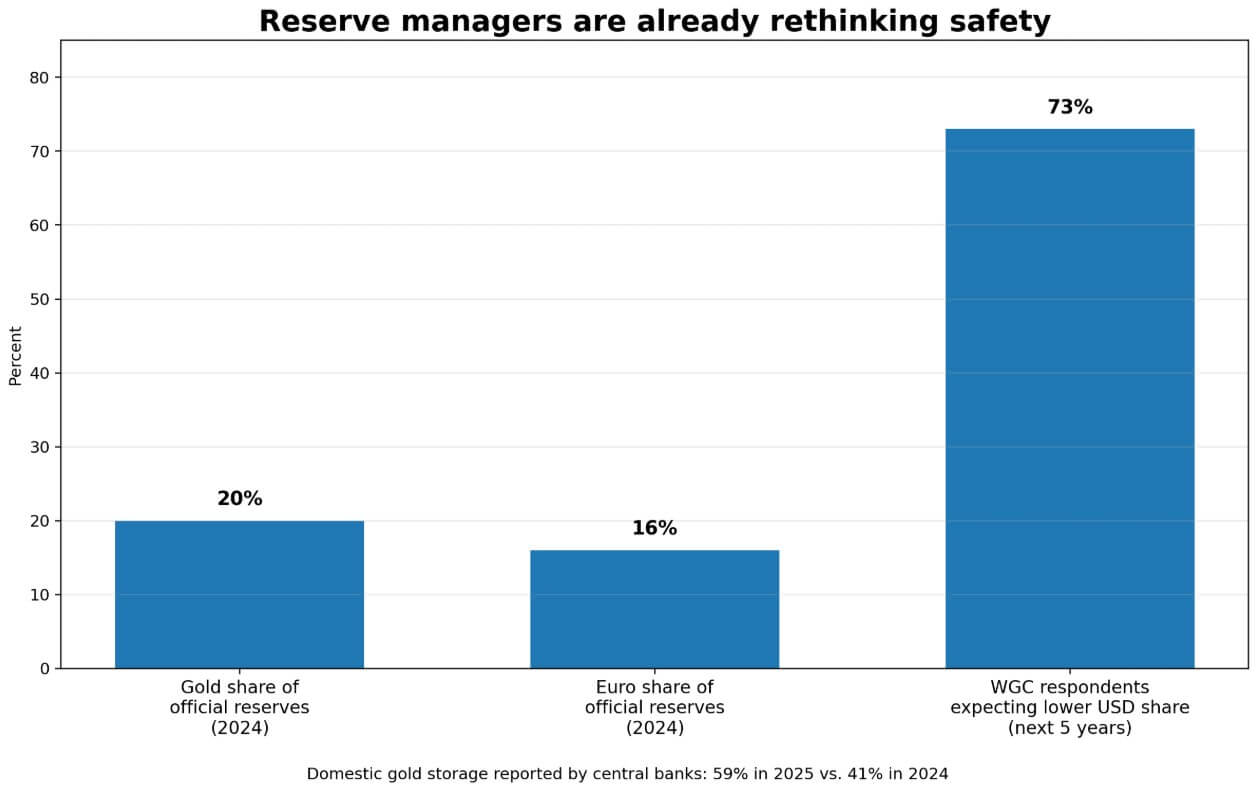
The ECB reported that gold’s share of the world’s official reserves will attain 20% in market worth phrases in 2024, exceeding the euro’s 16%, with central banks buying greater than 1,000 tonnes that 12 months.
The World Gold Council’s 2025 survey discovered that 73% of respondents anticipated US greenback holdings in world international change reserves to say no over the following 5 years, and the proportion of central banks reporting home gold storage rose to 59% from 41% a 12 months earlier.
Reserve managers have already expanded their definition of reserve danger, and the BPI paper extends that logic to Bitcoin as properly.
| property | Energy in regular occasions | important vulnerability | Failure modes underneath stress | Why is it necessary within the article? |
|---|---|---|---|---|
| US greenback reserves / authorities bonds | Considerable liquidity, excessive creditworthiness, and world reserve requirements | Could also be politically constrained by host nation insurance policies, sanctions, or custody implications | Freeze / Conditional Entry / Political Stress | It exhibits that whereas reserves stay “secure” on paper, they turn out to be tougher to spend in observe |
| gold | Lengthy-standing reserve ballast extensively accepted by public establishments, inflation hedge | Troublesome to maneuver rapidly, simply trapped bodily, liable to seizures and transportation bottlenecks | Stranding/seizure/logistics failure | Be taught why portability and bodily management have gotten extra necessary in reserve evaluation |
| Bitcoin | Digitally moveable and cell, like a courier, with out the necessity for transport routes or bodily transport. | Excessive volatility, governance burden and restricted public sector acceptance | Institutional reluctance/coverage hesitationreasonably than bodily immobilization | Quite than a standard secure stockpile, it enters the story as a possible asset for accessibility as a final resort. |
| Diversified Non-Greenback Sovereign Paper | Suits into conventional reserve frameworks whereas lowering dependence on a single reserve issuer | Nonetheless depending on exterior sovereign techniques, cost infrastructure and market entry | Exterior dependence/decreased neutrality | Acts as a substitute in case of bears: reserve managers might favor this to BTC even after accepting entry danger |
| gold saved domestically | Enhance management over storage administration whereas sustaining gold reserve position | Nonetheless affected by transportation friction and restricted portability throughout acute disaster | motion restrictions Quite than a pure custody danger | Displaying why gold can profit from the identical entry danger logic with out fully resolving it |
Dwelling proof of entry danger
The entry danger debate attracts power from concrete current occasions.
In March, Russia’s central financial institution objected to an EU freeze that affected about $300 billion of sovereign funds. This battle retains the central premise in play. Reserve property can turn out to be politically motionless, retaining their par worth.
Property which can be owned on paper however frozen in observe not function reserves, no matter their credit standing.
Brazil’s central financial institution drew an analogous conclusion. On March 31, Brazil elevated the proportion of gold in its reserves from 3.55% to 7.19% in a single 12 months, whereas reducing the proportion of the US greenback to 72, as a driver of diversification.
BPI’s paper argues that Bitcoin belongs to comparable decentralized calculations, significantly reserve determinations based mostly on geopolitical logic.
The US Strategic Bitcoin Reserve provides a separate knowledge level. The White Home order prioritizes confiscated BTC reserves, prohibits outright gross sales, and considers extra acquisitions solely on a budget-neutral foundation.
This could pull the language of the Bitcoin reserve into an precise sovereign management construction, setting a precedent no matter its unconventional funding supply.
Two futures within the sovereign Bitcoin debate
The size makes the bull’s case concrete. Taiwan’s international change reserves whole roughly $602 billion, with a 1% Bitcoin sleeve of roughly $6 billion and a 5% sleeve of $30 billion.
Extra intensive calculations are extra rigorous. 0.1% of worldwide reserves, roughly $16.25 billion, represents about 1.2% of Bitcoin’s whole market capitalization at its present worth of almost $68,000.
Participation within the reserve system, nevertheless small, will have an effect on costs lengthy earlier than central banks make main allocation selections.
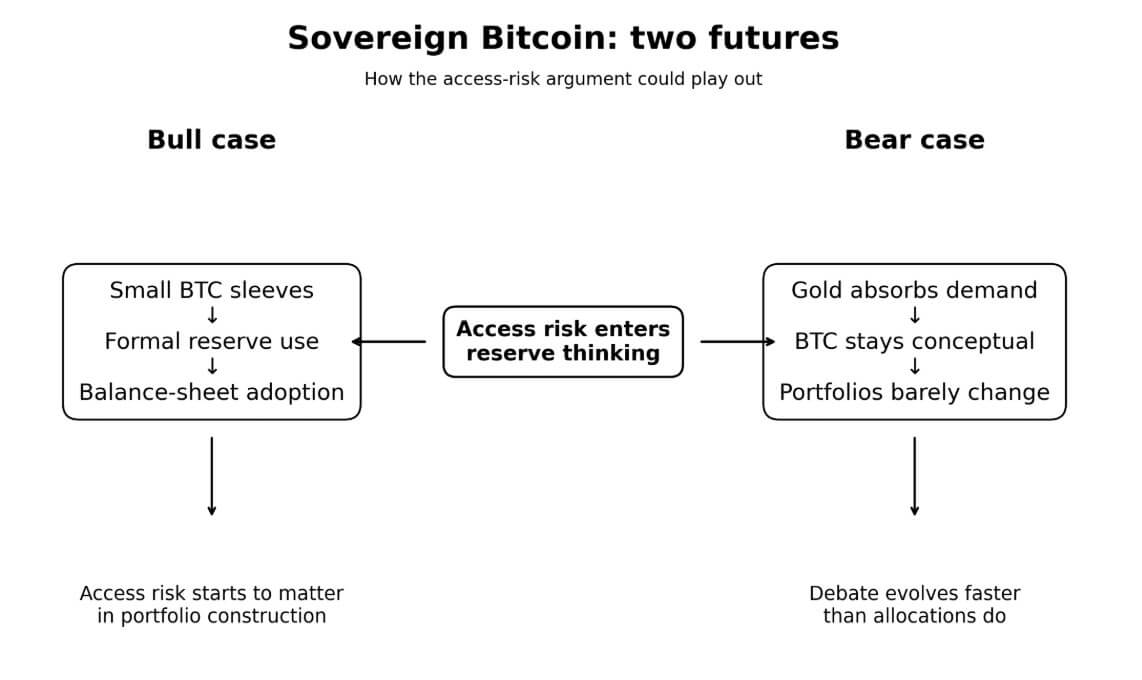
In a bullish case, a small variety of politically uncovered or sanctions-conscious states would first have to formally kind small BTC positions within the 0.25% to 1% vary, or deal with already seized or mined Bitcoin as reserve property earlier than making extra purchases.
Ferranti’s sanctions danger modeling helps this path. In a single sanctions state of affairs, his mannequin generates an optimum Bitcoin share of roughly 5% for uncovered sovereigns. The dialogue round sovereign Bitcoin will then transfer from advocacy paperwork to precise stability sheet inclusion.
The bear case accepts the entry danger criticism and nonetheless concludes that Bitcoin will lose.
Recognizing the logistical dependencies of bodily gold and the political dependencies of greenback reserves, reserve managers decided that Bitcoin’s volatility, governance burden, and near-zero acceptance by authorities departments meant that Bitcoin’s holding energy was weaker than that of domestically custodial gold or diversified non-dollar sovereign paper.
Gold will soak up the demand for diversification that entry and danger arguments have been thought to create for BTC, and Bitcoin’s position as a reserve asset stays conceptual. The dialogue evolves whereas the portfolio maintains its composition.
The place discussions are profitable and the place there may be stress
The BPI thesis is strongest when it treats portability and seizure resistance as true reserve properties based mostly on observable reserve habits.
The framework tracks official knowledge. Geopolitics is now visibly influencing the composition of international change reserves, and the need to carry property that aren’t concentrated in a single counterparty is actual and is already driving portfolios.
If adoption momentum or worth will increase are included as proof {that a} coverage case has been resolved, the paper goes too far. Public authorities proceed to concentrate on acceptability, authorized readability, and operational practices alongside entry danger, making these components necessary components not addressed in portability rankings.
Essentially the most dependable model of this paper’s argument is the place said by the paper itself. In different phrases, Bitcoin is just a little access-optimized insurance coverage sleeve alongside gold.
For many of Bitcoin’s historical past as a reserve coverage matter, the central query for presidency officers was whether or not Bitcoin was secure sufficient to carry. This framework persistently penalized BTC as its volatility was decrease than that of U.S. Treasuries and gold by each standard measure.
Reserve managers at the moment are targeted on which property might be deployed even within the occasion of a hostile geopolitical setting. The resurgence of gold, preferential therapy of home vaults, reserve disputes as a consequence of sanctions, and fragmentation of funds infrastructure all point out that reserve managers are already looking for conventional property.
Bitcoin proponents have inserted BTC into the identical dialog, and BPI’s paper exhibits how that argument works in its most subtle kind.