



USDT stablecoin issuer Tether has stepped in to anchor an enormous restoration plan for Drift Protocol, a Solana-based decentralized change (DEX) crippled by a $286 million exploit earlier this month.
Nevertheless, the rescue package deal comprises sturdy business strings. Difficult the Circle’s management of USDC on the Solana blockchain.
The restructuring plan requires Drift to desert its long-standing dependence on Circle Web Monetary’s USDC and pivot its total ecosystem to Tether’s USDT.
The deal marks a calculated offensive by Tether to realize market share in Solana, a blockchain that’s quickly rising as a significant battleground for retail funds and high-frequency decentralized finance (DeFi).
Whereas USDT stays the world’s liquidity king with a market capitalization of $185 billion, it has traditionally trailed Circle on the Solana community. By rescuing one of many ecosystem’s most distinguished protocols, Tether is successfully taking the highest spot.

The price of drifting lifeline
The restoration framework introduced on April 16 features a $127.5 million injection from Tether.
Further unnamed companions are anticipated to contribute an extra $20 million to fill the void left by the April 1 theft.
Investigators have since attributed the assault to North Korean cybercriminals, who allegedly spent months infiltrating the Drift workforce by “social engineering” by posing as authentic merchants at business conferences with a purpose to acquire the belief of builders.
To make customers entire, Drift points particular “restoration tokens.” In contrast to the protocol’s DRIFT governance belongings, these tokens characterize direct claims on a $295 million redemption pool.
The tokens will probably be transferable, permitting victims to instantly exit their positions and entry liquidity with out ready for regulation enforcement to take years to recuperate their belongings.
Nevertheless, a very powerful structural change is the “USDT First” mandate.
Drift’s total funds layer, the engine that clears and settles trades, will probably be migrated from USDC to USDT. The transfer brings over 128,000 energetic customers and 35 ecosystem companions below Tether’s umbrella.
Cindy Leow, co-founder of Drift, stated:
“This partnership is constructed round a transparent revenue-driven assortment mechanism designed to prioritize customers from day one by a revenue-linked credit score facility, ecosystem subsidies, and market maker financing.”
Leow additional defined that “a good portion of the change’s income is meant to fund a devoted person restoration pool, together with dedicated assist funds.”
How Tether’s USDT positive factors a foothold over Circle’s USDC
Some analysts body Drift’s pivot to USDT as an implicit however sharp criticism of Circle’s dealing with of exploits.
Instantly after the April 1st hack, a number of distinguished blockchain researchers, together with ZachXBT, publicly criticized Circle for not promptly freezing the stolen funds.
Nevertheless, the Circle defended its place, saying it might solely freeze USDC if legally compelled to take action by the suitable authorities and that “the ability to freeze isn’t a police energy.”
Whereas the USDC issuer additionally argued that unilateral intervention is inconsistent with due course of and safety of property rights, it additionally stated it stands able to assist accountability efforts inside the bounds of the regulation.
Whereas that response might have been legally and operationally in line with Circle’s regulatory place, it additionally uncovered business vulnerabilities. In moments of acute stress, cryptocurrency customers and protocols usually reward the occasion deemed to have acted quickest to guard funds, slightly than the one who made the cleanest authorized arguments.
The Circle perspective additionally contrasts with the Tether perspective. Tether usually leans into its position as an aggressive “policeman” by itself phrases, steadily freezing belongings in response to regulation enforcement requests or critical abuses.
“Tether strikes quicker in circumstances like this,” DeFi analyst Ignace stated. “I’ve all the time most well-liked USDC as it’s supposedly ‘safer’. Nevertheless, it was USDC that skilled the biggest depeg in the course of the banking disaster, whereas Circle didn’t freeze these hacked funds. Tether is positioning itself as a safer possibility for retail customers in search of safety.”
This opinion is echoed by USDT0 Bridge Protocol co-founder Lorenzo Romagnoli, who reportedly froze the Solana Bridge inside 29 minutes of the Drift exploit. He stated:
“Individuals are drawn to options that shield them in tough moments.”
The battle over Solana’s cost rails
Tether’s aggressive transfer comes as Solana’s significance within the world monetary system reaches a tipping level.
In February 2026, Grayscale reported that stablecoin buying and selling quantity on Solana reached a document $650 billion attributable to low charges and excessive throughput.
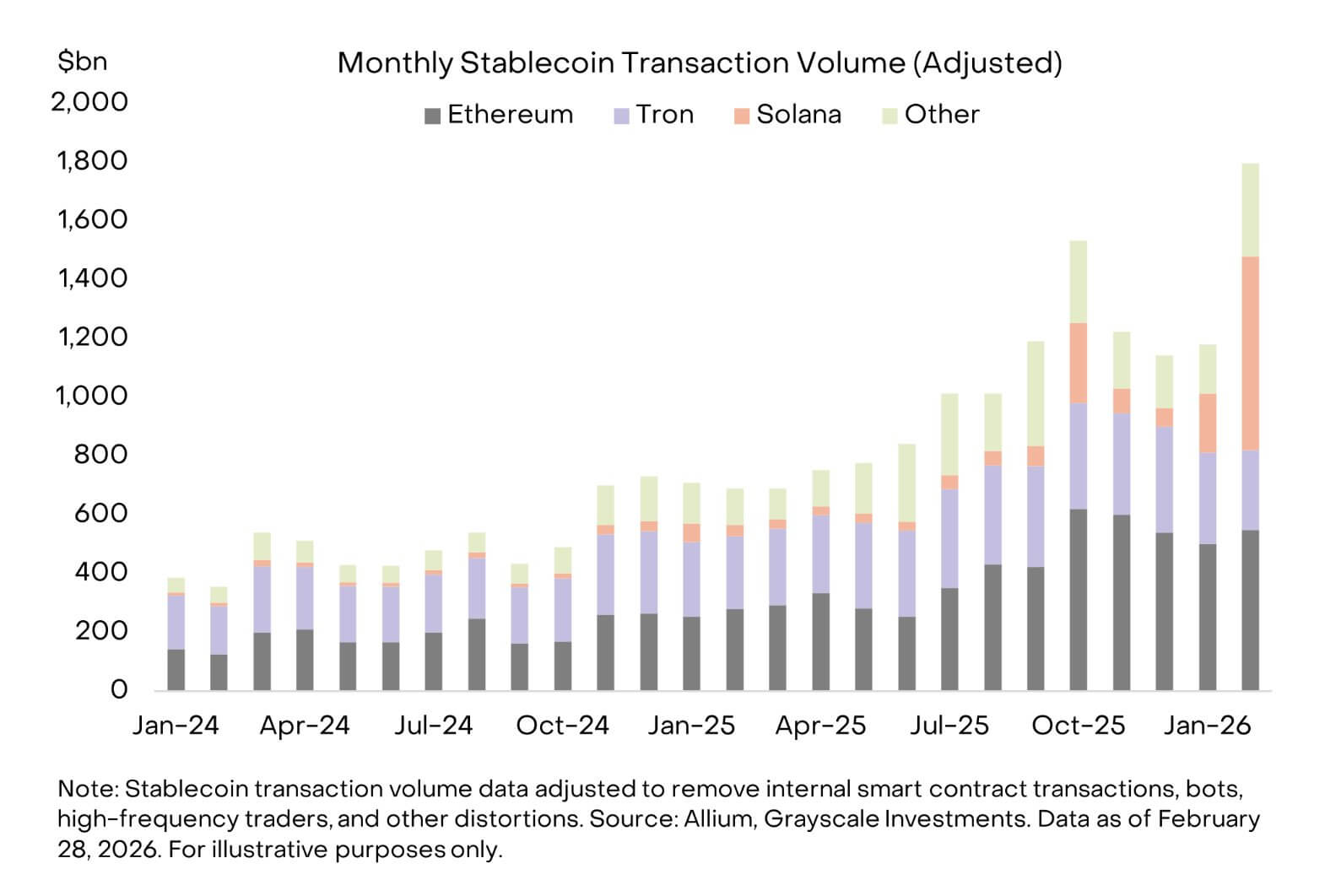
For years, Circle’s USDC has been a “Goldilocks” asset for Solana customers, with a present provide of over $8.1 billion, accounting for over 52% of the community’s whole stablecoin provide of $15.5 billion. Notably, USDC’s provide is almost triple Tether’s $3 billion value of provide.
This benefit is bolstered by partnerships with a number of conventional monetary giants equivalent to Visa, PayPal, Stripe, Western Union, and Fiserv, which run manufacturing workflows on the community.
However the tide could also be turning.
USDC’s market share in Solana has fallen from a peak of 80% to round 55% as of early 2026, in line with knowledge from Blockworks Analysis. Throughout the identical interval, USDT’s share rose to 21%.
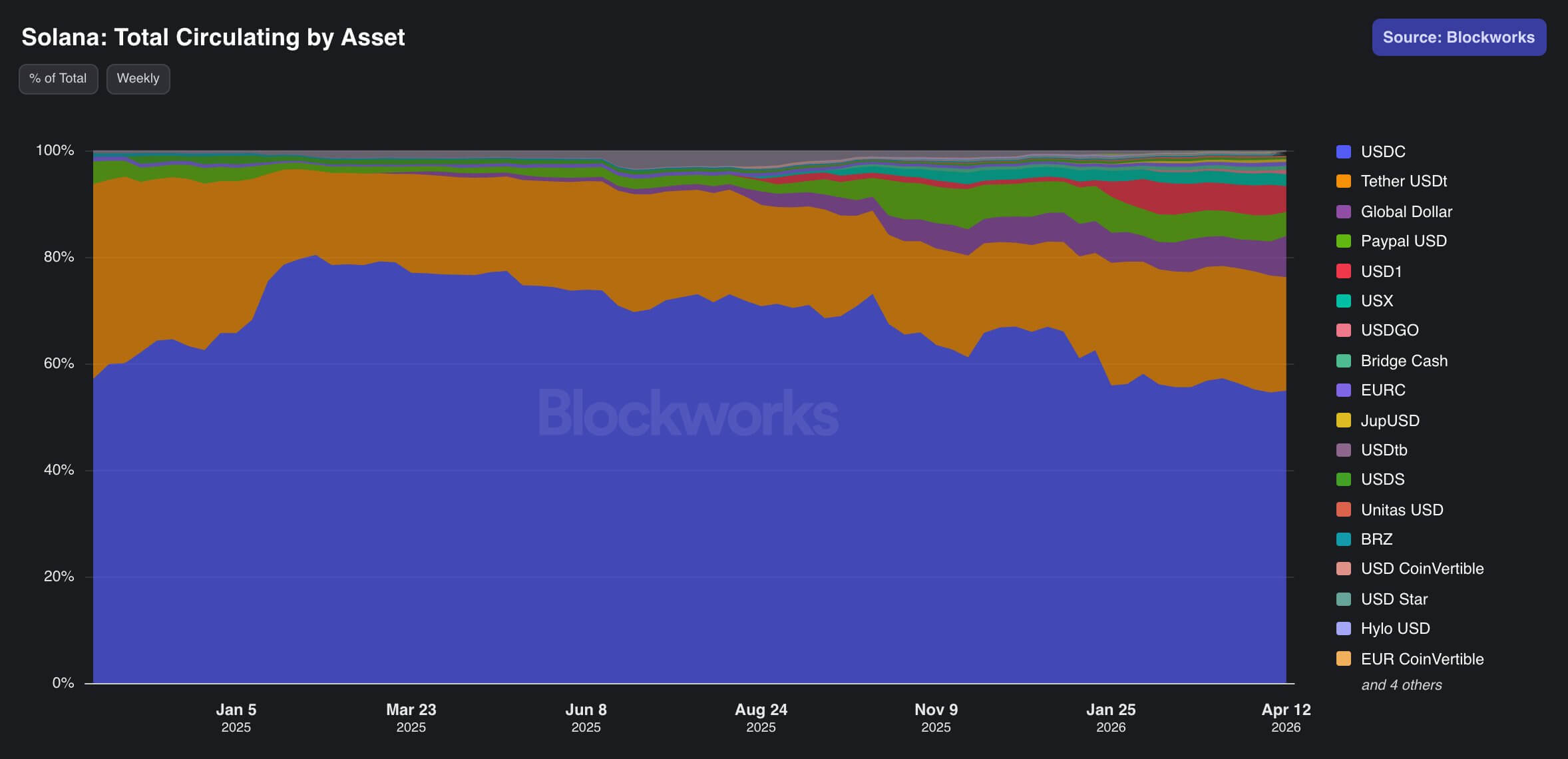
Market observers argue that Tether’s transfer to amass Drift might be an try and speed up this decline and seize the profitable charges that include quicker retail funds.
Impartial crypto analyst Truda opined:
“Suppose deeper: When you spend $100 million to rescue Drift, abruptly each different protocol on prime of Solana begins contemplating USDT as having an “implicit rescue mechanism.” It is a problem to overcome the world. ”
A brand new period of transparency?
In the meantime, Tether’s growth into Solana funds rails coincides with an unprecedented push for institutional legitimacy.
The corporate, lengthy thought-about a pariah within the U.S. regulatory world, is now making an attempt to shake off its status for opaqueness.
Tether has reportedly requested KPMG to transcend the “certificates” it has been utilizing for years and conduct a complete monetary audit of its $185 billion reserves.
This modification is being pushed partially by the GENIUS Act, a landmark US regulation that requires stablecoin issuers to satisfy stricter transparency requirements. As a part of this evolution, Tether not too long ago launched “USAT”, a specialised token compliant with the brand new US framework.
The transfer comes as the corporate can also be reportedly eyeing a significant $20 billion funding spherical, valuing the El Salvador-based firm at $500 billion.
Nevertheless, the Monetary Instances reported that some buyers stay hesitant, citing the historic weight of Tether’s $18.5 million settlement with the New York lawyer basic in 2021 and ongoing investigations into USDT’s use in illicit financing.
However, these efforts permit Circle to compete extra straight with the regulatory stance that it has lengthy used as a core benefit of the USDC stablecoin.
As such, the cryptocurrency business is watching carefully as Drift prepares to reopen following an audit by safety companies OtterSec and Asymetric.
“Drift Reduction” is greater than only a restoration plan. It’s a sign that Tether is now not content material to be the reserve foreign money of offshore exchanges. The corporate needs to be the cost tier of future retail funds, and is prepared to pay a nine-figure sum to safe that spot.