

On March thirtieth, Google Quantum AI printed a 57-page white paper co-authored by Justin Drake of the Ethereum Basis and Dan Boneh of Stanford College.
The paper exhibits that round 500,000 bodily qubits are wanted to interrupt by the 256-bit elliptic curve discrete logarithm drawback, the cryptographic basis underlying most blockchain transactions, a 20x discount from earlier estimates.
This compression signifies that a sufficiently superior quantum pc can decrypt a Bitcoin non-public key in about 9 minutes, with reside transactions falling inside a 10-minute block affirmation window and a likelihood of theft of about 41%.
Days earlier, Google had set a deadline of 2029 to finish the {industry}’s post-quantum transition.

These numbers have sparked anticipated curiosity in when quantum computer systems will be capable of crack Bitcoin. ”
It additionally introduced up one other query requested by Bloomberg’s Eric Balchunas and Bitcoin analyst Checkmate.
Checkmate requested,
This paper, if I perceive accurately, is saying that Google has cracked the design of a quantum pc associated to cryptography.
That is an enormous deal.
Why, why did they focus their papers on our blockchain baggage?
It is not authorities code. Not banking infrastructure or web protocols.
Humorous cash on the web.
Balciunas added:
To not downplay the risk (that is the entire dialogue from September), however why would Google apply this investigative money and time to cryptocurrencies and one thing with extra societal implications like army protection methods, world banking methods, and even non-public electronic mail? Is Bitcoin actually their largest concern?
So why did Google select blockchain as one of the crucial important accountable disclosure automobiles within the historical past of public-key cryptography?
Not Bitcoin Paper
The paper’s attain is increasing. Google clarifies that vulnerabilities in stablecoins and tokenization have been missed within the literature, after which dedicates sections to USDT and USDC administrative keys, centralizing Ethereum validators, and tokenizing real-world belongings.
The doc predicts that tokenized belongings may drive quantum-fragile worth to over $16 trillion by 2030. Co-authored by researchers from the Ethereum Basis and Stanford College, the paper is framed as an argument for an industry-wide shift.
The numbers Google chooses to publish make the vulnerability apparent.
Roughly 1.7 million BTC, practically 9% of all Bitcoin, resides in P2PK scripts with public keys uncovered on-chain, and susceptible dormant Bitcoin may attain 2.3 million BTC throughout script sorts.
A complete of roughly 6.9 million BTC is at excessive threat, together with wallets opened with Taproot’s default public key disclosure. On Ethereum, the 1,000 richest public accounts maintain roughly 20.5 million ETH, and a sufficiently superior machine may deplete the account inside 9 days.
These are observable on-chain info. Researchers can confirm them with out accessing banks’ inner methods, authorities registries, or telcos’ personal PKIs.

Google has been pursuing post-quantum cryptography since 2016.
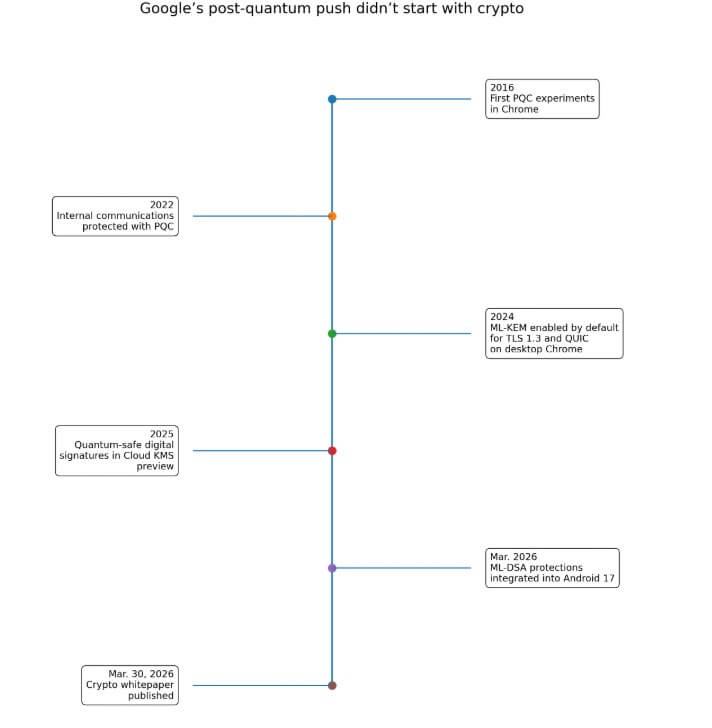
The corporate ran its first PQC experiment in Chrome that yr, secured inner communications with PQC in 2022, enabled TLS 1.3 and ML-KEM for QUIC by default in desktop Chrome in 2024, launched quantum-secure digital signatures in Cloud KMS preview in 2025, and rolled out ML-DSA-based PQC safety to Android 17 in March 2026. It has been built-in into.
This cryptocurrency whitepaper is a public case research of 1 fastidiously managed migration that Google is already implementing throughout its infrastructure. Google withheld the precise assault vector and as a substitute printed a zero-knowledge proof, permitting anybody to confirm the useful resource estimates with out accessing the assault roadmap.
The corporate coordinated with the US authorities earlier than publication.
Present geopolitics amplifies that timing. The US goals to finish its first PQC customary in 2024 and obtain full {industry} transition by 2035. South Korea has the identical purpose of 2035. In response to the report, China is working in the direction of establishing nationwide PQC requirements inside three years.
Google’s paper is a part of an accelerating requirements race, with cryptocurrencies serving as essentially the most seen public discussion board for the way that race will play out in observe.

”)
Why use cryptocurrencies particularly?
Google’s personal introduction supplies one reply. Cryptocurrencies “stand out” amongst quantum susceptible methods. It’s because many blockchains rely closely on ECDLP-based elliptic curve cryptography, which could be damaged by smaller quantum computer systems than comparable RSA methods.
| aspect | Crypto/Blockchain | Closed monetary system or conventional system |
|---|---|---|
| Main cryptographic leaks | Excessive dependence on ECDLP-based curves | Combined methods, typically with poor transparency |
| Treatments after signature forgery | Typically nothing. Losses could be ultimate | Regulation of fraud, cancellation and authorized measures |
| Observability | Show public keys, member swimming pools, and dormant wallets on-chain | Inside methods are non-public |
| governance | Open, decentralized, sluggish consensus | Central authorities can mandate upgrades |
| failure mode | public and irreversible | Typically tactically contained |
Moreover, blockchains sometimes don’t have any recourse if a fraudulent switch is permitted by a cast signature.
The mix of intensive cryptographic publicity and irreversible failure makes cryptography the clearest venue to reveal what post-quantum signature collapse seems like.
Beneath the technical debate is a governance debate. The paper particularly states that resulting from Bitcoin’s decentralized construction and “lack of a single heart of energy,” key rotation and dormant asset insurance policies could require “a prolonged consensus-building course of.”
Whereas a centralized authority deploys software program updates by a single authority, a Bitcoin equal requires decentralized consensus, a course of that runs publicly at a tempo that the group permits.
We now have chosen an space the place transition issues play out brazenly, the place failures are persistent and public, and the place no single authority can remedy coordination issues by command.
The identical weak encryption protects TLS internet site visitors, firmware updates, end-to-end messaging, Passport, MFA, SSH, and DNS.
Blockchains layer on prime of all of the distinctive set of properties of open networks, akin to public key registries, observable reminiscence swimming pools, on-chain dormant wallets, and governance discussions that run in real-time and are open to everybody.
The inference supported by the construction of this paper is that these properties present a venue for Google to explain the exploding vary of signature migration failures in observable public phrases earlier than the identical migration is required in methods much less tolerant of public failures.
what to anticipate
This doc may drive chains, wallets, and stablecoin issuers to make PQC transitions seen and measurable early on.
Google has already pointed to reside or check deployments of PQC on Algorand, Solana, and the XRP Ledger.
Initiatives that reveal a clear key rotation path, help for hybrid signatures, and a trusted method to dormant belongings achieve governance credibility that they’ll carry into the tokenization wave.
Cryptocurrencies will then transfer from being the primary seen website of quantum vulnerabilities to the primary public laboratory for post-quantum belief infrastructure, and Google’s paper would be the foundational doc for that transition.
The result’s managed disclosure, forcing a few of the hardest governance debates earlier than quantum computer systems existed in relation to cryptography.
| state of affairs | what occurs | what it means |
|---|---|---|
| bull case | Chains, wallets, and stablecoin issuers make PQC transitions seen and measurable early | Cryptography turns into first public laboratory for post-quantum belief infrastructure |
| bear case | Coordination fails, Bitcoin key rotation politics drags on, validator/managed key complexities stay unresolved | Crypto supplies the perfect instance of how belief transitions can go unsuitable in public |
If alignment visibly fails, Bitcoin’s consensus politics will lengthen key rotations, the complexities of Ethereum-style validators and administrative keys will stay unresolved, and stablecoins or tokenized belongings will start to decide on host chains disproportionately relying on PQC readiness.
The 6.9 million BTC saved in high-value wallets represents a everlasting debt that the community can’t handle and not using a breakthrough in social coordination. It has by no means been managed at this scale.
Google’s paper has aged into a distinct type of report. Briefly, it’s a doc that cryptocurrencies have earned their place in analysis by the visibility of their failure modes and finality of loss, and that essentially the most vital methods require a wholly completely different type of disclosure.
Google launched its findings as a managed warning in regards to the Web’s coming belief transition, selecting domains the place that transition could be carried out in public, irreversible if it fails, and never delegated to a single authority.